
Are poinsettias poisonous to cats? (and the holiday flower that is far more dangerous)
TL;DR: Are poinsettias poisonous to cats? Yes, but only mildly. Pet Poison Helpline says a poinsettia causes only mild signs, usually drooling or vomiting that goes away on its own. The holiday plant to really worry about is the lily in a gift bouquet. A tiny amount of a true lily can cause kidney failure in a cat, and that includes the pollen.
The poinsettia shows up the week after Thanksgiving. Red leaves, foil wrap, a good spot on the side table. Within the hour your cat has found it.
One sniff. A slow chew on the corner of a leaf. Then a look that says the leaf was a letdown and the matter is closed.
This is usually when owners panic, because the poinsettia has a reputation as a holiday killer. It does not deserve it. The real danger tends to arrive quietly, wrapped in cellophane, as a bouquet someone thought made a lovely gift.
Are poinsettias poisonous to cats? Mildly, and mostly in the mouth
The ASPCA lists the poinsettia as toxic to cats. Read the rest of the entry, though. It blames an irritant sap and describes the plant as “irritating to the mouth and stomach, sometimes causing vomiting, but generally over-rated in toxicity.”
Pet Poison Helpline’s holiday plants page comes to the same conclusion. Poinsettias are considered poisonous, but “only mild clinical signs occur.” Expect drooling and vomiting, and diarrhea only rarely. The helpline says these signs usually clear up on their own.
That still does not make the plant a snack. The Cornell Feline Health Center notes that just a small piece of plants such as poinsettias could be enough to make a cat ill. So you are looking at an unpleasant afternoon, not an emergency.
What to do: keep the poinsettia, just not where your cat can graze on it. If a leaf goes missing, watch for drooling or vomiting. Call your vet if the signs do not settle.
The bouquet that deserves the real fear
Pet Poison Helpline lists lilies on the same holiday page, and the tone changes completely. True lilies (Lilium and Hemerocallis, which are the daylilies) can cause kidney failure in cats. The helpline’s lily entry names the Easter, Madonna and Oriental lily. It also names the Stargazer and Tiger lily.
Every part of the plant counts. The helpline lists the leaf, stem and flower. It also lists the pollen and even the vase water. Cornell says lilies can cause life-threatening kidney failure if a cat eats even a tiny amount.
The first signs look ordinary. The helpline lists vomiting, abdominal pain and dehydration. Acute kidney failure can follow. Speed decides how it ends. ASPCA guidance for veterinarians says treatment that starts more than 18 hours after exposure may leave kidney damage that cannot be reversed.
That is why the advice is so blunt. Pet Poison Helpline says a cat needs treatment even if only a little pollen is seen on its fur. Nobody has to see the cat eat anything.
Not every plant called a lily works this way. Peace lilies contain calcium oxalate crystals that irritate the mouth. ASPCA guidance says lily of the valley does not harm the kidneys but affects the heart instead. Neither belongs within reach.
What to do: a bouquet with lilies in it does not come inside. Pull the lilies out at the door, or give the whole thing to a friend without cats.
Key takeaway: The poinsettia gets the warnings, but the lily does the damage. A poinsettia means drool and a cleanup. A lily means a same-day vet visit, even if all you saw was pollen.
Holly, mistletoe and amaryllis sit in the middle
These three are worse than a poinsettia and nowhere near as bad as a lily. How much your cat ate matters a great deal.
Holly contains saponins. Pet Poison Helpline says it can cause significant stomach upset. Most pets drool and shake their heads because the spiky leaves hurt. Eating a lot can bring severe vomiting, diarrhea and a refusal to eat.
Mistletoe depends on the type. The helpline says American mistletoe is less of a concern than European varieties. A small amount usually causes mild signs. A large amount can cause heart problems and low blood pressure. It can also cause trouble walking, seizures and even death.
Amaryllis contains lycorine, according to the ASPCA’s amaryllis entry. The signs it lists include vomiting, diarrhea and abdominal pain. It also lists drooling, depression, loss of appetite and tremors.
One plant on the holiday shelf gets a clean bill. The ASPCA lists the Christmas cactus as non-toxic to cats. If you want something that flowers and can sit at cat height, buy that one.
Which holiday plants are poisonous to cats: the quick table
| Plant | How serious | What to do |
|---|---|---|
| Lily (true lilies, daylilies) | Can cause kidney failure | Keep it out of the house. Any contact means a same-day vet visit. |
| Mistletoe | Mild in small amounts, dangerous in large amounts | Keep it well out of reach. Call if your cat ate more than a nibble. |
| Holly | Stomach upset, sore mouth | Keep it up high. Call if vomiting keeps going. |
| Amaryllis | Vomiting, tremors possible | Put it in a room your cat cannot get into. Call your vet if your cat chews it. |
| Poinsettia | Mild drooling or vomiting | Watch your cat. Call if the signs do not settle. |
| Christmas cactus | Listed as non-toxic | The safe swap. |
Three ideas people get backward
- “She seems fine, so it is fine.” The early signs of lily poisoning look like an ordinary upset stomach. ASPCA guidance says treatment that starts more than 18 hours after exposure may leave kidney damage that cannot be reversed. Waiting to see how she does is the mistake.
- “The poinsettia is the dangerous one.” The ASPCA calls it “generally over-rated in toxicity.” The gift bouquet on the counter is the bigger risk.
- “Make him throw it up.” Cornell says plainly not to make a cat vomit unless you are specifically told to. Call your vet or a poison line first.
How to decorate without a standoff
None of this means a bare house. It means a little planning before the plants arrive.
Pro tip: Keep the plant tag until the holidays are over. If your cat chews something, the tag tells your vet or the poison line exactly what it was. Save both helpline numbers below in your phone tonight.
If you are decorating a tree this year as well, our guide on how to keep your cat out of the Christmas tree covers the branches and ornaments. Holidays bring a lot of new things into a cat’s reach. Our post on Halloween hazards works through the same problem for October.
When it is worth a vet call (and when it is a same-day one)
A same-day call is any contact with a true lily. That includes chewing, drinking the vase water or pollen on the fur. It also includes a large amount of mistletoe or holly. Do not wait for symptoms.
For a nibble of poinsettia, watch first. Call your vet if the drooling or vomiting keeps going. Pet Poison Helpline says supportive care may be given if the signs persist.
If your vet is closed, call an emergency clinic or a poison line. Pet Poison Helpline lists (855) 764-7661 on its own page and says it is open 24/7. The ASPCA Animal Poison Control number is (888) 426-4435.
Watch out: Do not try to make your cat vomit at home. Cornell warns against it unless you are specifically told to do it. Call your vet or a poison line first and follow what they say.
Quick answers
Can a poinsettia kill a cat?
Pet Poison Helpline says poinsettias cause only mild signs, such as drooling and vomiting. These usually go away on their own. Call your vet if they persist.
Is a Christmas cactus safe for cats?
Yes. The ASPCA lists the Christmas cactus as non-toxic to cats. It is a good swap for the riskier holiday plants.
What should I do if my cat ate a lily?
Get to a vet the same day, even if your cat seems fine. ASPCA guidance says treatment that starts more than 18 hours after exposure may leave kidney damage that cannot be reversed.
Is mistletoe poisonous to cats?
Yes. A small amount usually causes mild signs. Pet Poison Helpline says a large amount can affect the heart and blood pressure and can cause seizures.
Give your cat something better to chew on than the centerpiece
A cat with a puzzle to solve or a window to watch spends less time investigating your plants. These picks from our shop give that curiosity somewhere safe to go.


Why the plant sniff is worth respecting
Your cat noticed the new plant before anyone in the house had taken off their coat. That close attention is a big part of why cats are such good company. They really do notice everything you bring home.
It is also why the plants matter. A cat that checks everything will eventually taste something. Pick plants that make that taste boring instead of dangerous, and the holidays stay calm for both of you.
Loved this post? Explore more cat care tips on our cat blog, or read our guide to winter care for cats.
About the Author: Milly Brown

A quick heads up
Some links in our posts are affiliate links. If you buy through one, we may earn a small commission at no extra cost to you. How it works
Shop the aisles
Hand-picked, well-reviewed gear for every kind of cat.
How old is your cat in human years?
Our free calculator works it out in seconds. No math, no judgment.
Fresh off the blog
Are poinsettias poisonous to cats? (and the holiday flower that is far more dangerous)
TL;DR: Are poinsettias poisonous to cats? Yes, but only mildly. Pet Poison Helpline says a poinsettia causes only mild signs, usually drooling or vomiting that goes away on its own. The holiday plant to really worry about is the lily in a gift bouquet. A tiny amount of a true lily can cause kidney failure in a cat, and that includes the pollen.
The poinsettia shows up the week after Thanksgiving. Red leaves, foil wrap, a good spot on the side table. Within the hour your cat has found it.
One sniff. A slow chew on the corner of a leaf. Then a look that says the leaf was a letdown and the matter is closed.
This is usually when owners panic, because the poinsettia has a reputation as a holiday killer. It does not deserve it. The real danger tends to arrive quietly, wrapped in cellophane, as a bouquet someone thought made a lovely gift.
Are poinsettias poisonous to cats? Mildly, and mostly in the mouth
The ASPCA lists the poinsettia as toxic to cats. Read the rest of the entry, though. It blames an irritant sap and describes the plant as “irritating to the mouth and stomach, sometimes causing vomiting, but generally over-rated in toxicity.”
Pet Poison Helpline’s holiday plants page comes to the same conclusion. Poinsettias are considered poisonous, but “only mild clinical signs occur.” Expect drooling and vomiting, and diarrhea only rarely. The helpline says these signs usually clear up on their own.
That still does not make the plant a snack. The Cornell Feline Health Center notes that just a small piece of plants such as poinsettias could be enough to make a cat ill. So you are looking at an unpleasant afternoon, not an emergency.
What to do: keep the poinsettia, just not where your cat can graze on it. If a leaf goes missing, watch for drooling or vomiting. Call your vet if the signs do not settle.
The bouquet that deserves the real fear
Pet Poison Helpline lists lilies on the same holiday page, and the tone changes completely. True lilies (Lilium and Hemerocallis, which are the daylilies) can cause kidney failure in cats. The helpline’s lily entry names the Easter, Madonna and Oriental lily. It also names the Stargazer and Tiger lily.
Every part of the plant counts. The helpline lists the leaf, stem and flower. It also lists the pollen and even the vase water. Cornell says lilies can cause life-threatening kidney failure if a cat eats even a tiny amount.
The first signs look ordinary. The helpline lists vomiting, abdominal pain and dehydration. Acute kidney failure can follow. Speed decides how it ends. ASPCA guidance for veterinarians says treatment that starts more than 18 hours after exposure may leave kidney damage that cannot be reversed.
That is why the advice is so blunt. Pet Poison Helpline says a cat needs treatment even if only a little pollen is seen on its fur. Nobody has to see the cat eat anything.
Not every plant called a lily works this way. Peace lilies contain calcium oxalate crystals that irritate the mouth. ASPCA guidance says lily of the valley does not harm the kidneys but affects the heart instead. Neither belongs within reach.
What to do: a bouquet with lilies in it does not come inside. Pull the lilies out at the door, or give the whole thing to a friend without cats.
Key takeaway: The poinsettia gets the warnings, but the lily does the damage. A poinsettia means drool and a cleanup. A lily means a same-day vet visit, even if all you saw was pollen.
Holly, mistletoe and amaryllis sit in the middle
These three are worse than a poinsettia and nowhere near as bad as a lily. How much your cat ate matters a great deal.
Holly contains saponins. Pet Poison Helpline says it can cause significant stomach upset. Most pets drool and shake their heads because the spiky leaves hurt. Eating a lot can bring severe vomiting, diarrhea and a refusal to eat.
Mistletoe depends on the type. The helpline says American mistletoe is less of a concern than European varieties. A small amount usually causes mild signs. A large amount can cause heart problems and low blood pressure. It can also cause trouble walking, seizures and even death.
Amaryllis contains lycorine, according to the ASPCA’s amaryllis entry. The signs it lists include vomiting, diarrhea and abdominal pain. It also lists drooling, depression, loss of appetite and tremors.
One plant on the holiday shelf gets a clean bill. The ASPCA lists the Christmas cactus as non-toxic to cats. If you want something that flowers and can sit at cat height, buy that one.
Which holiday plants are poisonous to cats: the quick table
| Plant | How serious | What to do |
|---|---|---|
| Lily (true lilies, daylilies) | Can cause kidney failure | Keep it out of the house. Any contact means a same-day vet visit. |
| Mistletoe | Mild in small amounts, dangerous in large amounts | Keep it well out of reach. Call if your cat ate more than a nibble. |
| Holly | Stomach upset, sore mouth | Keep it up high. Call if vomiting keeps going. |
| Amaryllis | Vomiting, tremors possible | Put it in a room your cat cannot get into. Call your vet if your cat chews it. |
| Poinsettia | Mild drooling or vomiting | Watch your cat. Call if the signs do not settle. |
| Christmas cactus | Listed as non-toxic | The safe swap. |
Three ideas people get backward
- “She seems fine, so it is fine.” The early signs of lily poisoning look like an ordinary upset stomach. ASPCA guidance says treatment that starts more than 18 hours after exposure may leave kidney damage that cannot be reversed. Waiting to see how she does is the mistake.
- “The poinsettia is the dangerous one.” The ASPCA calls it “generally over-rated in toxicity.” The gift bouquet on the counter is the bigger risk.
- “Make him throw it up.” Cornell says plainly not to make a cat vomit unless you are specifically told to. Call your vet or a poison line first.
How to decorate without a standoff
None of this means a bare house. It means a little planning before the plants arrive.
Pro tip: Keep the plant tag until the holidays are over. If your cat chews something, the tag tells your vet or the poison line exactly what it was. Save both helpline numbers below in your phone tonight.
If you are decorating a tree this year as well, our guide on how to keep your cat out of the Christmas tree covers the branches and ornaments. Holidays bring a lot of new things into a cat’s reach. Our post on Halloween hazards works through the same problem for October.
When it is worth a vet call (and when it is a same-day one)
A same-day call is any contact with a true lily. That includes chewing, drinking the vase water or pollen on the fur. It also includes a large amount of mistletoe or holly. Do not wait for symptoms.
For a nibble of poinsettia, watch first. Call your vet if the drooling or vomiting keeps going. Pet Poison Helpline says supportive care may be given if the signs persist.
If your vet is closed, call an emergency clinic or a poison line. Pet Poison Helpline lists (855) 764-7661 on its own page and says it is open 24/7. The ASPCA Animal Poison Control number is (888) 426-4435.
Watch out: Do not try to make your cat vomit at home. Cornell warns against it unless you are specifically told to do it. Call your vet or a poison line first and follow what they say.
Quick answers
Can a poinsettia kill a cat?
Pet Poison Helpline says poinsettias cause only mild signs, such as drooling and vomiting. These usually go away on their own. Call your vet if they persist.
Is a Christmas cactus safe for cats?
Yes. The ASPCA lists the Christmas cactus as non-toxic to cats. It is a good swap for the riskier holiday plants.
What should I do if my cat ate a lily?
Get to a vet the same day, even if your cat seems fine. ASPCA guidance says treatment that starts more than 18 hours after exposure may leave kidney damage that cannot be reversed.
Is mistletoe poisonous to cats?
Yes. A small amount usually causes mild signs. Pet Poison Helpline says a large amount can affect the heart and blood pressure and can cause seizures.
Give your cat something better to chew on than the centerpiece
A cat with a puzzle to solve or a window to watch spends less time investigating your plants. These picks from our shop give that curiosity somewhere safe to go.
Why the plant sniff is worth respecting
Your cat noticed the new plant before anyone in the house had taken off their coat. That close attention is a big part of why cats are such good company. They really do notice everything you bring home.
It is also why the plants matter. A cat that checks everything will eventually taste something. Pick plants that make that taste boring instead of dangerous, and the holidays stay calm for both of you.
Loved this post? Explore more cat care tips on our cat blog, or read our guide to winter care for cats.
How to keep your cat out of the Christmas tree (and the one decoration that turns into a vet bill)
TL;DR
To keep your cat out of the Christmas tree, make the tree hard to reach and dull once your cat gets there. Anchor it, clear away nearby furniture and cover the base with foil or a deterrent mat. Then give your cat a better place to climb and short play sessions every day. Skip tinsel completely, because swallowed tinsel can mean surgery.
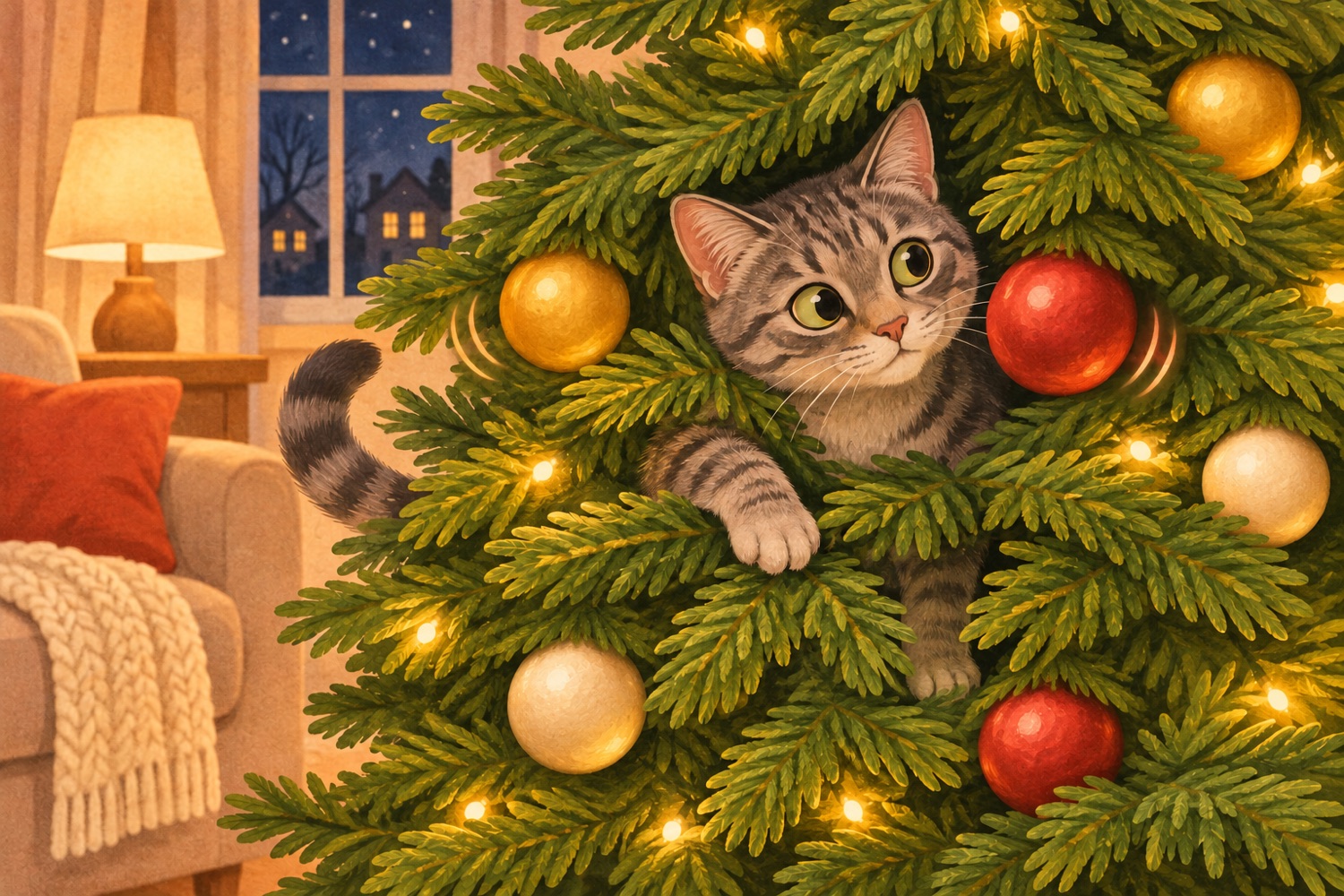
Day two of the tree. The lights are on and the ornaments are hung. Somewhere around the fourth branch, a pair of eyes is looking back at you.
Most people read this as mischief. Or spite, if the angel ends up on the floor.
It is neither. A tall new object full of hiding spots and dangling toys just appeared in the middle of your cat’s territory. Climbing it is not misbehaving. It is the obvious thing to do.
Why your cat treats the Christmas tree like a jungle gym
PetMD’s guide on this, reviewed by veterinarian Jennifer Coates, puts it plainly. In a cat’s eyes the tree is “a perfect toy, scratching post, and place to climb.” It offers “a high-up space with lots of hiding spots and things to play with.”
Then there is the surprise of it. The same guide notes that “the novelty of having a tree moved indoors is just too much for many cats to resist.” Your cat did not ask for a forest in the living room. Now there is one, and it needs inspecting.
Which means the tree is not the problem. The tree is meeting three needs at once: height, cover and play. Take those away from the tree. Then offer them somewhere else, and most of the climbing loses its point.
Before you change anything, watch for a day. What your cat goes for first tells you which fix matters most.
- Climbing: anchoring and launch points come first.
- Batting ornaments: change what hangs on the lower third.
- Chewing: needles, branches and cords are the priority.
- Drinking from the stand: the water is the whole job.
The tree hazards that matter more than a broken ornament
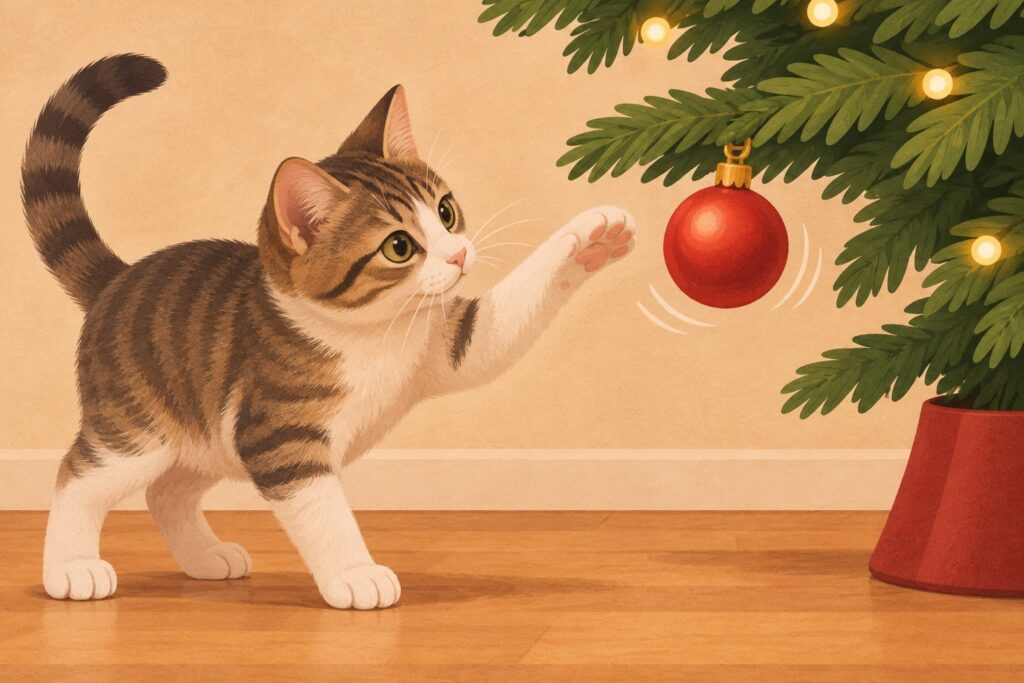
A toppled tree is loud and memorable. It is rarely the worst thing that happens. The quieter risks sit in the branches and the stand, and they are easy to miss because nothing crashes.
| Item | Why it matters | What to do |
|---|---|---|
| Tinsel | Can cause severe vomiting, a blocked gut and dehydration. Surgery may be needed. | Do not use it at all |
| Tree water | Can grow bacteria. Additives like fertilizer, preservatives or xylitol can be toxic. | Cover the stand. Plain water only. |
| Real needles | Fir, spruce and pine needles are mildly toxic and can irritate the mouth or stomach. | Sweep fallen needles daily |
| Artificial branches | Chewed plastic or aluminum can irritate the mouth. | Block access to chewers |
| Light cords | A chewed wire can deliver a potentially lethal shock. | Use a heavy plastic cord protector |
| Glass ornaments | Shards can damage the mouth and digestive tract. | Hang high or leave boxed |
| Ornament hooks | Dangerous if chewed or swallowed. | Tie ornaments on with cloth loops |
| Long gift ribbon | Cornell advises against long ribbon ties under the tree. | Use short ties or none |
| Candles | A curious cat can knock one over. | Never leave one burning unattended |
The needle risk is real but modest. PetMD’s veterinary guide says a cat would need to eat a lot of needles to become severely ill. Tinsel is a different story.
Key takeaway
The falling tree is the dramatic risk. Tinsel and string are the dangerous ones. If you change only one thing this year, leave the tinsel in the store.
How to keep your cat out of the Christmas tree, step by step
Work through these in order. The first two are about safety. The rest make the tree less interesting than everything around it.
Pro tip
Cornell’s Feline Health Center makes this point about the scents and tastes used to keep cats off a tree: “Not all cats dislike the same things, so you may need to experiment.” The same goes for textures. Try one deterrent at a time for a few days. If your cat strolls straight across the foil, switch to a mat before adding anything else.
The spray bottle teaches the wrong lesson
The spray bottle feels like a fast answer. PetMD’s guide advises against it. Spraying can teach your cat to fear you. It can also teach your cat to climb the tree when you are gone.
Scented oils are the other trap. Some older advice suggests peppermint or other pungent oils on the lower branches. PetMD warns that “many essential oils are toxic to cats.” Skip them. Foil, mats and distance do the job without the risk.
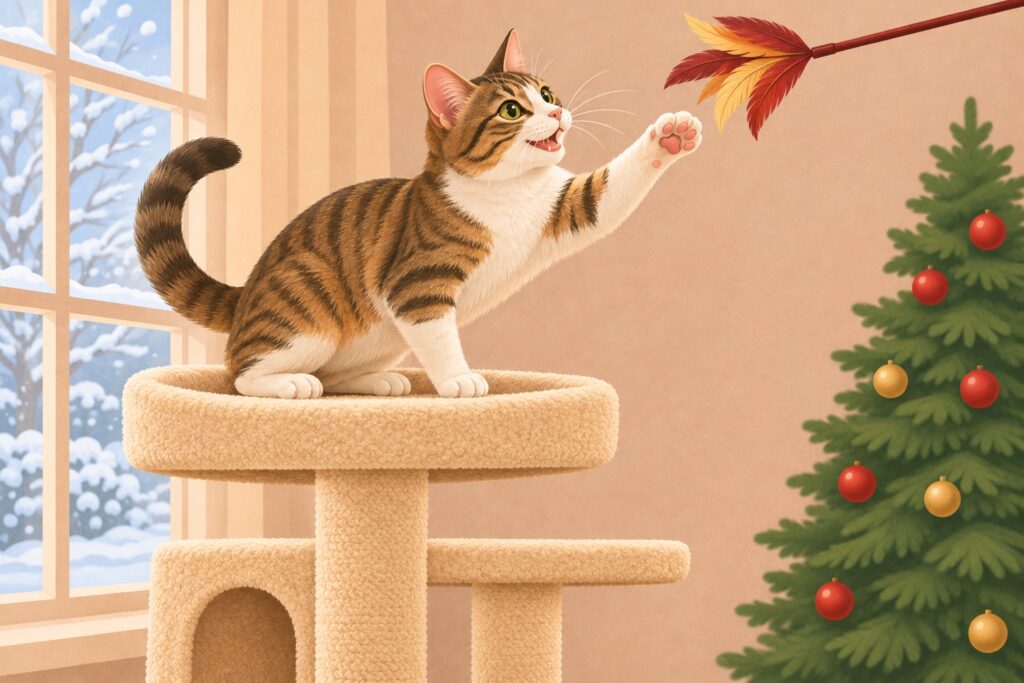
What works better is boring and reliable. PetMD suggests several short play sessions a day with a wand or chase toy. A cat that has already stalked and pounced has less to prove to a spruce. If your cat already delivers toys in the small hours, our piece on why your cat brings you toys at 3am explains where that energy comes from.
If none of it works, change the tree rather than the cat. A small tabletop tree is much harder to climb. A pet playpen around a full-size tree keeps everyone apart (check the current price). It is not pretty. It is still prettier than the tree on its side.
When a tree mishap is worth a vet call
Most tree incidents end with a swept-up bauble. A few do not, and these are the ones to act on.
- Same-day vet call: you saw your cat swallow tinsel, ribbon, string or yarn. VCA calls long, thin objects like these a linear foreign body. Surgery is typically needed.
- Same-day vet call: your cat chewed through a light cord. The ASPCA warns that a wire can deliver a potentially lethal shock.
- Call your vet or a poison line: your cat ate needles or drank tree water with additives. PetMD advises calling for any amount of needles eaten. The ASPCA Animal Poison Control Center is at (888) 426-4435.
- Watch for these signs: VCA lists vomiting, refusal to eat, dehydration and lethargy as the most common signs of a swallowed string. Belly pain, hiding more than usual or not wanting to lie down can also show up.
Watch out
If you see tinsel or string hanging from your cat’s mouth, do not pull it. PetMD’s veterinarian-written guide warns that “pulling the loose end of the string can cause serious damage to their organs.” VCA notes that a torn intestine can lead to peritonitis, which can be life-threatening. Keep your cat calm and call your vet now.
Gear that gives your cat a better place to climb
The easiest way to win the tree argument is to offer something better nearby. These picks from our shop give your cat height, a view and water that is not in a tree stand.



Quick answers
Is tinsel dangerous for cats?
Yes. Swallowed tinsel can cause severe vomiting, a blocked gut and dehydration, and surgery may be needed. The safest choice is not to use it at all.
Are Christmas tree needles toxic to cats?
Fir, spruce and pine needles are mildly toxic and can irritate the mouth or stomach. PetMD says a cat would need to eat a lot of them to become severely ill, so sweeping fallen needles daily is enough for most homes.
Can my cat drink the Christmas tree water?
Keep the stand covered. Tree water can grow bacteria, and additives like fertilizer, preservatives or xylitol can be toxic. Use plain water with nothing added.
How do I stop my cat climbing the Christmas tree?
Anchor the tree, move nearby furniture your cat uses as a launch pad, and make the base unpleasant with foil or a deterrent mat. Then give your cat a better tower in the same room.
A cat in the tree is a cat paying attention
There is something quietly flattering about it. You carried a forest indoors and your cat noticed every inch of it.
The climbing and the batting come from the same instinct. Find the high ground. Check the new thing. Play with whatever moves.
Give that instinct a safer outlet and the tree can go back to being decoration. Your cat still gets a whole season of new things to inspect. Most of them just will not be glass.
Loved this post? Explore more cat care tips on our cat blog, or read what goes wrong when cats wear costumes before the holiday photos start.
Lost cat? What to do in the first 24 hours (an hour-by-hour plan)
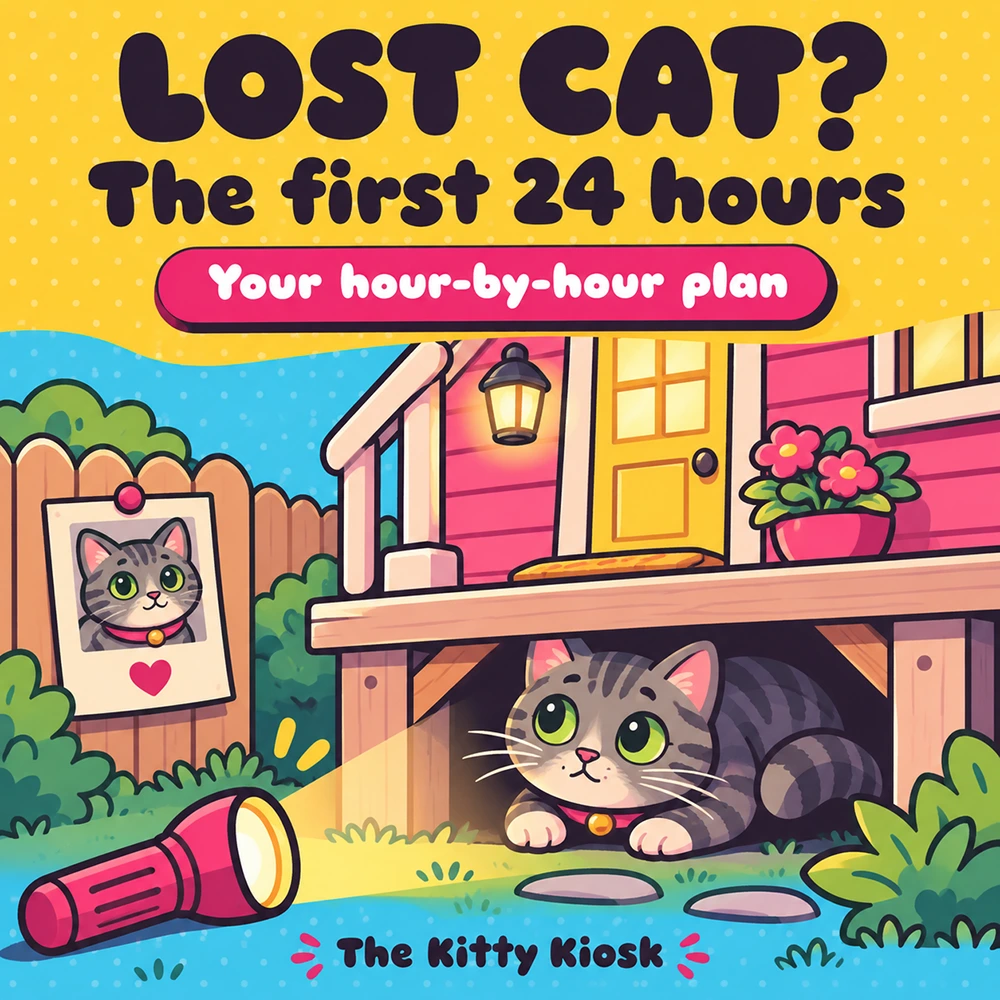
It usually starts with something small. The back door didn’t quite latch. The screen had a corner pulled loose. A delivery driver stood in the doorway a beat too long. Then the house goes quiet in a way you notice before you understand it, and you start calling a name that doesn’t answer.
If that is where you are right now, take one breath and read the next two sections. They matter more than anything else on this page.
We wrote this as a plan you can follow hour by hour, because panic makes everybody search in the wrong places. The good news is that the odds are on your side when you do the right things early.
The first hour: search close, slow, and quiet
Start inside. Seriously. A frightened cat can wedge itself into places you would swear are too small: inside a recliner, under the springs of a bed, behind the dryer, in the back of a closet, or up inside a kitchen cabinet with a gap at the top. Rosie’s go-to hiding spot is the space behind our bed, and she has ignored her own name from back there for the better part of an hour. Open every cabinet and closet, and use a flashlight.
Once you are sure the house is empty, go outside, but slow down. Lost cats are rarely running down the street. Far more often they are tucked under something within a few houses of home, silent and frozen, hoping nobody finds them.
A 2018 study of missing cats published in the journal Animals found that indoor-only cats were usually found very close to where they got out, and that physically searching the neighborhood found more cats than any other method. Cats that are used to going outside tend to travel farther, but even they rarely go as far as owners fear.
Walk the area slowly and look low: under porches and decks, beneath parked cars, inside bushes, along fence lines, and in window wells. Call in a normal, calm voice, then stop and listen for a full minute. A scared cat may answer with a tiny sound or not at all, and it will not come running toward a stranger’s voice or yours if you sound upset.
Hours one and two: knock on doors and ask for camera clips
Your neighbors are your best search party, and most of them will be glad to help if you ask directly.
Knock on every door within a few houses on each side and across the street. Show a photo on your phone and ask two specific things. First, can they check their garage, shed, and basement? Cats slip into open garages and get shut in all the time, and that is one of the most common places lost cats turn up. Second, do they have a doorbell or yard camera?
That second question is the one people forget. Ring, Blink, Nest, and other cameras record motion all night, and a cat crossing a driveway at 2am is exactly the kind of thing they catch. Ask neighbors to scroll back through the clips from the time your cat went missing. A single screenshot can tell you which direction to search.
Hours two to four: posters up, and post online
Paper posters still work, because the people most likely to spot your cat are the ones who walk and drive past your street every day. Keep the design simple enough to read from a moving car: “LOST CAT” in huge letters, one clear photo, your cat’s name, where and when they were last seen, and a phone number in large print.
You can make one in a couple of minutes with our free lost cat poster maker. It builds a printable poster with tear-off phone tabs plus a square image sized for social media, and you do not need an account.
Put posters up within a few blocks first: mailbox clusters, intersections, bus stops, school crossings, and the entrances to parks. Then widen out to vet clinics, pet stores, and community boards at grocery stores and laundromats.
Online, share the square image in your local Facebook lost-and-found pet groups and on Nextdoor. You can also give your cat a free listing on our Lost Cat Board, which puts them on a map, lets neighbors post sightings and camera screenshots, and emails you the moment someone does. It also adds a QR code to your poster, so anyone who sees it on a pole can report a sighting from their phone.
Hours four to eight: shelters, vets, and the microchip
Call your local animal shelter, animal control, and any nearby rescues. Then call vet clinics and the closest emergency vet, in case a good Samaritan brings in an injured cat. Give each one a description, your phone number, and ask how they log found animals.
Then go in person. Descriptions over the phone get missed (“gray cat” covers half the cats in a shelter), and stray hold periods can be short, sometimes only a few days depending on where you live. Plan to visit every couple of days, not once.
If your cat is microchipped, call the microchip company today. Confirm the chip is registered to you and that the phone number on file is current; an out-of-date number is one of the most common reasons a scanned cat does not make it home. If you are not sure which company holds the record, the AAHA Universal Pet Microchip Lookup at petmicrochiplookup.org can tell you.
After dark: the best search window of the day
This is the part most people skip, and it is often when cats are found. Once the street goes quiet, a hiding cat feels safe enough to move, and a flashlight makes their eyes shine back at you from under decks and hedges.
Go out around dusk, then again late at night and at first light. Walk slowly, stop often, and call softly. Shake a treat bag or tap a food can with a spoon if that is a sound your cat knows. If you spot them, resist the urge to grab. Sit down, look away, talk quietly, and let them come to you, even if it takes twenty minutes.
Back at home, leave something that smells like you and like them near the door they got out of: a worn T-shirt, their bed, or a blanket they sleep on. If the trail goes cold, ask your shelter or a local rescue about borrowing a humane trap. They are safe, and they catch cats who are too frightened to come to anyone.
Day two and beyond: keep going
If the first day ends without your cat, you have not failed. Cats are found weeks and even months after they go missing, often because a poster finally reached the right person or a shy cat finally got hungry enough to come out.
Keep visiting shelters in person. Refresh your online posts every few days so they stay near the top of local groups. Replace posters that have faded or blown down. Post updates on your listing when you learn something new, like a sighting a few streets over, so the people following along know where to look.
When they come home
Book a vet check, even if your cat seems fine. A few days outside can mean dehydration, small wounds, or fleas you will not spot right away.
Then take the next step to make it less likely to happen again. Make sure your cat has a microchip with up-to-date details and a breakaway collar with an ID tag carrying your phone number, which is the fastest way a neighbor can reach you. If your cat is a door-dasher, our look at GPS and Bluetooth trackers for cats covers the options. For cats who clearly want more of the outdoors, these safe indoor and outdoor compromises can take the pressure off the front door.
And if your cat goes outside regularly, our guide to outdoor cat safety covers the hazards that catch most owners off guard. Trips are another common time for escapes, so our tips for traveling with your cat are worth a look before the next car ride.
Lastly, if you listed your cat on the Lost Cat Board, mark them as found. It lets everyone who helped know the good news, and every happy ending gives hope to the next person standing in their driveway calling a name.
Loved this post? Explore more cat care tips on our cat blog, or dig into Outdoor cat safety: the five threats people forget about for a deeper look at keeping your cat safe beyond the front door.
Your turn
Leave a comment
Tried this with your own cat? Tell us how it went. We read every comment.
Keep reading
More from the Kiosk
Your cat is asleep on something important. Plenty of time for one more.

The 5 Best Robot Cat Litter Boxes
Cats are fabulous, but let’s face it—cleaning the litter box? Not so fabulous. Thankfully, robot cat litter boxes are [...]

Introducing The Kitty Kiosk Cat Name Generator
Naming a new furry family member is one of the most exciting parts of welcoming a kitty into your [...]

Cat Anxiety: Tell-Tale Behavior, Causes, and Remedies
If your cat has ever bolted under the bed at the sound of a doorbell or spent hours staring [...]
Still curious?