
How to keep your cat out of the Christmas tree (and the one decoration that turns into a vet bill)
TL;DR
To keep your cat out of the Christmas tree, make the tree hard to reach and dull once your cat gets there. Anchor it, clear away nearby furniture and cover the base with foil or a deterrent mat. Then give your cat a better place to climb and short play sessions every day. Skip tinsel completely, because swallowed tinsel can mean surgery.
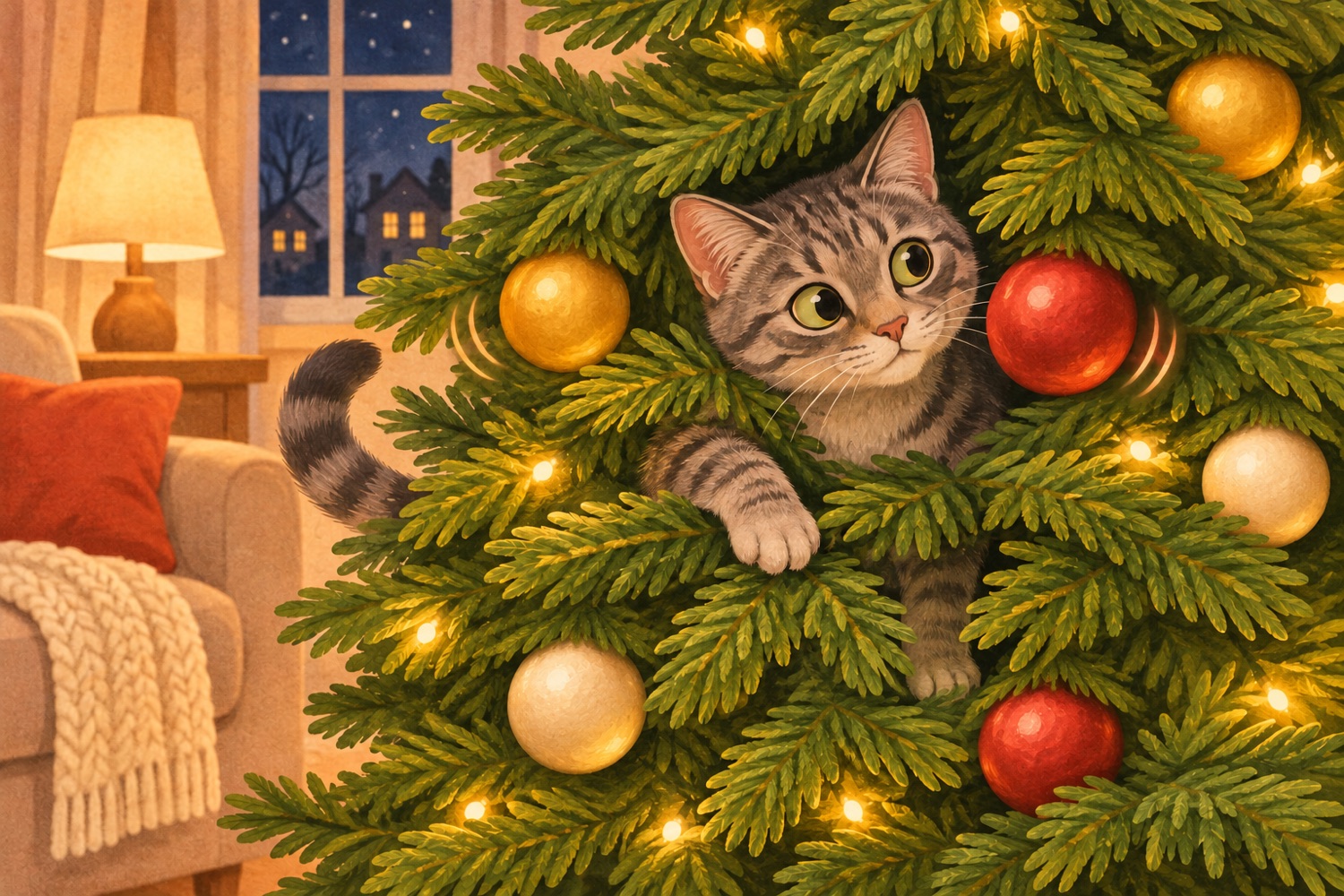
Day two of the tree. The lights are on and the ornaments are hung. Somewhere around the fourth branch, a pair of eyes is looking back at you.
Most people read this as mischief. Or spite, if the angel ends up on the floor.
It is neither. A tall new object full of hiding spots and dangling toys just appeared in the middle of your cat’s territory. Climbing it is not misbehaving. It is the obvious thing to do.
Why your cat treats the Christmas tree like a jungle gym
PetMD’s guide on this, reviewed by veterinarian Jennifer Coates, puts it plainly. In a cat’s eyes the tree is “a perfect toy, scratching post, and place to climb.” It offers “a high-up space with lots of hiding spots and things to play with.”
Then there is the surprise of it. The same guide notes that “the novelty of having a tree moved indoors is just too much for many cats to resist.” Your cat did not ask for a forest in the living room. Now there is one, and it needs inspecting.
Which means the tree is not the problem. The tree is meeting three needs at once: height, cover and play. Take those away from the tree. Then offer them somewhere else, and most of the climbing loses its point.
Before you change anything, watch for a day. What your cat goes for first tells you which fix matters most.
- Climbing: anchoring and launch points come first.
- Batting ornaments: change what hangs on the lower third.
- Chewing: needles, branches and cords are the priority.
- Drinking from the stand: the water is the whole job.

The tree hazards that matter more than a broken ornament
A toppled tree is loud and memorable. It is rarely the worst thing that happens. The quieter risks sit in the branches and the stand, and they are easy to miss because nothing crashes.
| Item | Why it matters | What to do |
|---|---|---|
| Tinsel | Can cause severe vomiting, a blocked gut and dehydration. Surgery may be needed. | Do not use it at all |
| Tree water | Can grow bacteria. Additives like fertilizer, preservatives or xylitol can be toxic. | Cover the stand. Plain water only. |
| Real needles | Fir, spruce and pine needles are mildly toxic and can irritate the mouth or stomach. | Sweep fallen needles daily |
| Artificial branches | Chewed plastic or aluminum can irritate the mouth. | Block access to chewers |
| Light cords | A chewed wire can deliver a potentially lethal shock. | Use a heavy plastic cord protector |
| Glass ornaments | Shards can damage the mouth and digestive tract. | Hang high or leave boxed |
| Ornament hooks | Dangerous if chewed or swallowed. | Tie ornaments on with cloth loops |
| Long gift ribbon | Cornell advises against long ribbon ties under the tree. | Use short ties or none |
| Candles | A curious cat can knock one over. | Never leave one burning unattended |
The needle risk is real but modest. PetMD’s veterinary guide says a cat would need to eat a lot of needles to become severely ill. Tinsel is a different story.
Key takeaway
The falling tree is the dramatic risk. Tinsel and string are the dangerous ones. If you change only one thing this year, leave the tinsel in the store.
How to keep your cat out of the Christmas tree, step by step
Work through these in order. The first two are about safety. The rest make the tree less interesting than everything around it.
Pro tip
Cornell’s Feline Health Center makes this point about the scents and tastes used to keep cats off a tree: “Not all cats dislike the same things, so you may need to experiment.” The same goes for textures. Try one deterrent at a time for a few days. If your cat strolls straight across the foil, switch to a mat before adding anything else.
The spray bottle teaches the wrong lesson
The spray bottle feels like a fast answer. PetMD’s guide advises against it. Spraying can teach your cat to fear you. It can also teach your cat to climb the tree when you are gone.
Scented oils are the other trap. Some older advice suggests peppermint or other pungent oils on the lower branches. PetMD warns that “many essential oils are toxic to cats.” Skip them. Foil, mats and distance do the job without the risk.
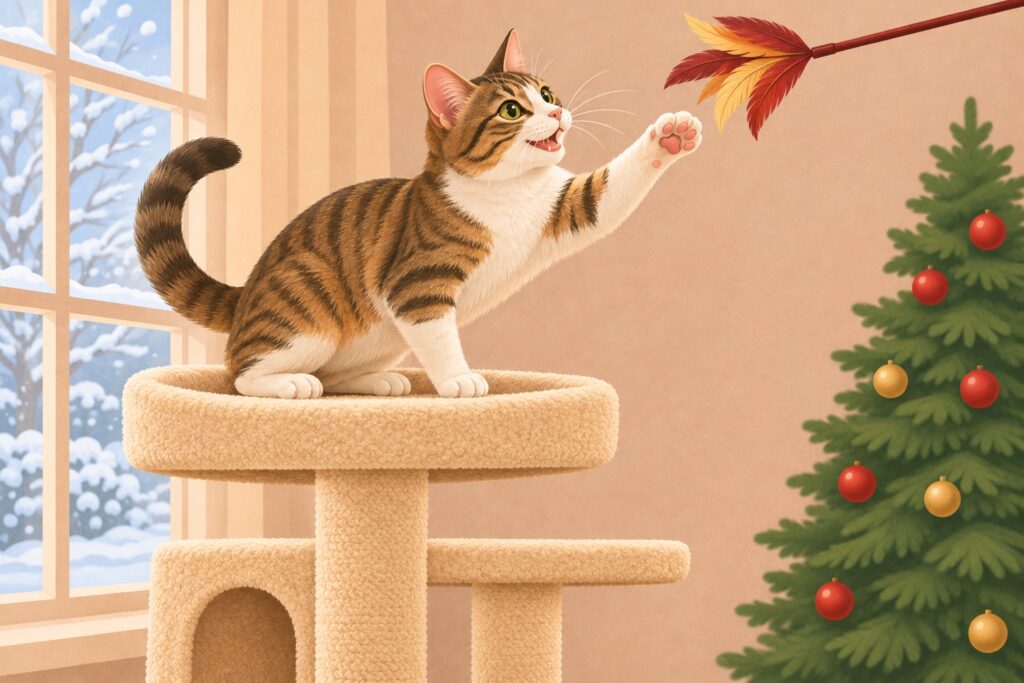
What works better is boring and reliable. PetMD suggests several short play sessions a day with a wand or chase toy. A cat that has already stalked and pounced has less to prove to a spruce. If your cat already delivers toys in the small hours, our piece on why your cat brings you toys at 3am explains where that energy comes from.
If none of it works, change the tree rather than the cat. A small tabletop tree is much harder to climb. A pet playpen around a full-size tree keeps everyone apart (check the current price). It is not pretty. It is still prettier than the tree on its side.
When a tree mishap is worth a vet call
Most tree incidents end with a swept-up bauble. A few do not, and these are the ones to act on.
- Same-day vet call: you saw your cat swallow tinsel, ribbon, string or yarn. VCA calls long, thin objects like these a linear foreign body. Surgery is typically needed.
- Same-day vet call: your cat chewed through a light cord. The ASPCA warns that a wire can deliver a potentially lethal shock.
- Call your vet or a poison line: your cat ate needles or drank tree water with additives. PetMD advises calling for any amount of needles eaten. The ASPCA Animal Poison Control Center is at (888) 426-4435.
- Watch for these signs: VCA lists vomiting, refusal to eat, dehydration and lethargy as the most common signs of a swallowed string. Belly pain, hiding more than usual or not wanting to lie down can also show up.
Watch out
If you see tinsel or string hanging from your cat’s mouth, do not pull it. PetMD’s veterinarian-written guide warns that “pulling the loose end of the string can cause serious damage to their organs.” VCA notes that a torn intestine can lead to peritonitis, which can be life-threatening. Keep your cat calm and call your vet now.
Gear that gives your cat a better place to climb
The easiest way to win the tree argument is to offer something better nearby. These picks from our shop give your cat height, a view and water that is not in a tree stand.



Quick answers
Is tinsel dangerous for cats?
Yes. Swallowed tinsel can cause severe vomiting, a blocked gut and dehydration, and surgery may be needed. The safest choice is not to use it at all.
Are Christmas tree needles toxic to cats?
Fir, spruce and pine needles are mildly toxic and can irritate the mouth or stomach. PetMD says a cat would need to eat a lot of them to become severely ill, so sweeping fallen needles daily is enough for most homes.
Can my cat drink the Christmas tree water?
Keep the stand covered. Tree water can grow bacteria, and additives like fertilizer, preservatives or xylitol can be toxic. Use plain water with nothing added.
How do I stop my cat climbing the Christmas tree?
Anchor the tree, move nearby furniture your cat uses as a launch pad, and make the base unpleasant with foil or a deterrent mat. Then give your cat a better tower in the same room.
A cat in the tree is a cat paying attention
There is something quietly flattering about it. You carried a forest indoors and your cat noticed every inch of it.
The climbing and the batting come from the same instinct. Find the high ground. Check the new thing. Play with whatever moves.
Give that instinct a safer outlet and the tree can go back to being decoration. Your cat still gets a whole season of new things to inspect. Most of them just will not be glass.
Loved this post? Explore more cat care tips on our cat blog, or read what goes wrong when cats wear costumes before the holiday photos start.
About the Author: Milly Brown

A quick heads up
Some links in our posts are affiliate links. If you buy through one, we may earn a small commission at no extra cost to you. How it works
Shop the aisles
Hand-picked, well-reviewed gear for every kind of cat.
How old is your cat in human years?
Our free calculator works it out in seconds. No math, no judgment.
Fresh off the blog
How to keep your cat out of the Christmas tree (and the one decoration that turns into a vet bill)
TL;DR
To keep your cat out of the Christmas tree, make the tree hard to reach and dull once your cat gets there. Anchor it, clear away nearby furniture and cover the base with foil or a deterrent mat. Then give your cat a better place to climb and short play sessions every day. Skip tinsel completely, because swallowed tinsel can mean surgery.
Day two of the tree. The lights are on and the ornaments are hung. Somewhere around the fourth branch, a pair of eyes is looking back at you.
Most people read this as mischief. Or spite, if the angel ends up on the floor.
It is neither. A tall new object full of hiding spots and dangling toys just appeared in the middle of your cat’s territory. Climbing it is not misbehaving. It is the obvious thing to do.
Why your cat treats the Christmas tree like a jungle gym
PetMD’s guide on this, reviewed by veterinarian Jennifer Coates, puts it plainly. In a cat’s eyes the tree is “a perfect toy, scratching post, and place to climb.” It offers “a high-up space with lots of hiding spots and things to play with.”
Then there is the surprise of it. The same guide notes that “the novelty of having a tree moved indoors is just too much for many cats to resist.” Your cat did not ask for a forest in the living room. Now there is one, and it needs inspecting.
Which means the tree is not the problem. The tree is meeting three needs at once: height, cover and play. Take those away from the tree. Then offer them somewhere else, and most of the climbing loses its point.
Before you change anything, watch for a day. What your cat goes for first tells you which fix matters most.
- Climbing: anchoring and launch points come first.
- Batting ornaments: change what hangs on the lower third.
- Chewing: needles, branches and cords are the priority.
- Drinking from the stand: the water is the whole job.
The tree hazards that matter more than a broken ornament
A toppled tree is loud and memorable. It is rarely the worst thing that happens. The quieter risks sit in the branches and the stand, and they are easy to miss because nothing crashes.
| Item | Why it matters | What to do |
|---|---|---|
| Tinsel | Can cause severe vomiting, a blocked gut and dehydration. Surgery may be needed. | Do not use it at all |
| Tree water | Can grow bacteria. Additives like fertilizer, preservatives or xylitol can be toxic. | Cover the stand. Plain water only. |
| Real needles | Fir, spruce and pine needles are mildly toxic and can irritate the mouth or stomach. | Sweep fallen needles daily |
| Artificial branches | Chewed plastic or aluminum can irritate the mouth. | Block access to chewers |
| Light cords | A chewed wire can deliver a potentially lethal shock. | Use a heavy plastic cord protector |
| Glass ornaments | Shards can damage the mouth and digestive tract. | Hang high or leave boxed |
| Ornament hooks | Dangerous if chewed or swallowed. | Tie ornaments on with cloth loops |
| Long gift ribbon | Cornell advises against long ribbon ties under the tree. | Use short ties or none |
| Candles | A curious cat can knock one over. | Never leave one burning unattended |
The needle risk is real but modest. PetMD’s veterinary guide says a cat would need to eat a lot of needles to become severely ill. Tinsel is a different story.
Key takeaway
The falling tree is the dramatic risk. Tinsel and string are the dangerous ones. If you change only one thing this year, leave the tinsel in the store.
How to keep your cat out of the Christmas tree, step by step
Work through these in order. The first two are about safety. The rest make the tree less interesting than everything around it.
Pro tip
Cornell’s Feline Health Center makes this point about the scents and tastes used to keep cats off a tree: “Not all cats dislike the same things, so you may need to experiment.” The same goes for textures. Try one deterrent at a time for a few days. If your cat strolls straight across the foil, switch to a mat before adding anything else.
The spray bottle teaches the wrong lesson
The spray bottle feels like a fast answer. PetMD’s guide advises against it. Spraying can teach your cat to fear you. It can also teach your cat to climb the tree when you are gone.
Scented oils are the other trap. Some older advice suggests peppermint or other pungent oils on the lower branches. PetMD warns that “many essential oils are toxic to cats.” Skip them. Foil, mats and distance do the job without the risk.
What works better is boring and reliable. PetMD suggests several short play sessions a day with a wand or chase toy. A cat that has already stalked and pounced has less to prove to a spruce. If your cat already delivers toys in the small hours, our piece on why your cat brings you toys at 3am explains where that energy comes from.
If none of it works, change the tree rather than the cat. A small tabletop tree is much harder to climb. A pet playpen around a full-size tree keeps everyone apart (check the current price). It is not pretty. It is still prettier than the tree on its side.
When a tree mishap is worth a vet call
Most tree incidents end with a swept-up bauble. A few do not, and these are the ones to act on.
- Same-day vet call: you saw your cat swallow tinsel, ribbon, string or yarn. VCA calls long, thin objects like these a linear foreign body. Surgery is typically needed.
- Same-day vet call: your cat chewed through a light cord. The ASPCA warns that a wire can deliver a potentially lethal shock.
- Call your vet or a poison line: your cat ate needles or drank tree water with additives. PetMD advises calling for any amount of needles eaten. The ASPCA Animal Poison Control Center is at (888) 426-4435.
- Watch for these signs: VCA lists vomiting, refusal to eat, dehydration and lethargy as the most common signs of a swallowed string. Belly pain, hiding more than usual or not wanting to lie down can also show up.
Watch out
If you see tinsel or string hanging from your cat’s mouth, do not pull it. PetMD’s veterinarian-written guide warns that “pulling the loose end of the string can cause serious damage to their organs.” VCA notes that a torn intestine can lead to peritonitis, which can be life-threatening. Keep your cat calm and call your vet now.
Gear that gives your cat a better place to climb
The easiest way to win the tree argument is to offer something better nearby. These picks from our shop give your cat height, a view and water that is not in a tree stand.
Quick answers
Is tinsel dangerous for cats?
Yes. Swallowed tinsel can cause severe vomiting, a blocked gut and dehydration, and surgery may be needed. The safest choice is not to use it at all.
Are Christmas tree needles toxic to cats?
Fir, spruce and pine needles are mildly toxic and can irritate the mouth or stomach. PetMD says a cat would need to eat a lot of them to become severely ill, so sweeping fallen needles daily is enough for most homes.
Can my cat drink the Christmas tree water?
Keep the stand covered. Tree water can grow bacteria, and additives like fertilizer, preservatives or xylitol can be toxic. Use plain water with nothing added.
How do I stop my cat climbing the Christmas tree?
Anchor the tree, move nearby furniture your cat uses as a launch pad, and make the base unpleasant with foil or a deterrent mat. Then give your cat a better tower in the same room.
A cat in the tree is a cat paying attention
There is something quietly flattering about it. You carried a forest indoors and your cat noticed every inch of it.
The climbing and the batting come from the same instinct. Find the high ground. Check the new thing. Play with whatever moves.
Give that instinct a safer outlet and the tree can go back to being decoration. Your cat still gets a whole season of new things to inspect. Most of them just will not be glass.
Loved this post? Explore more cat care tips on our cat blog, or read what goes wrong when cats wear costumes before the holiday photos start.
Lost cat? What to do in the first 24 hours (an hour-by-hour plan)
It usually starts with something small. The back door didn’t quite latch. The screen had a corner pulled loose. A delivery driver stood in the doorway a beat too long. Then the house goes quiet in a way you notice before you understand it, and you start calling a name that doesn’t answer.
If that is where you are right now, take one breath and read the next two sections. They matter more than anything else on this page.
We wrote this as a plan you can follow hour by hour, because panic makes everybody search in the wrong places. The good news is that the odds are on your side when you do the right things early.
The first hour: search close, slow, and quiet
Start inside. Seriously. A frightened cat can wedge itself into places you would swear are too small: inside a recliner, under the springs of a bed, behind the dryer, in the back of a closet, or up inside a kitchen cabinet with a gap at the top. Rosie’s go-to hiding spot is the space behind our bed, and she has ignored her own name from back there for the better part of an hour. Open every cabinet and closet, and use a flashlight.
Once you are sure the house is empty, go outside, but slow down. Lost cats are rarely running down the street. Far more often they are tucked under something within a few houses of home, silent and frozen, hoping nobody finds them.
A 2018 study of missing cats published in the journal Animals found that indoor-only cats were usually found very close to where they got out, and that physically searching the neighborhood found more cats than any other method. Cats that are used to going outside tend to travel farther, but even they rarely go as far as owners fear.
Walk the area slowly and look low: under porches and decks, beneath parked cars, inside bushes, along fence lines, and in window wells. Call in a normal, calm voice, then stop and listen for a full minute. A scared cat may answer with a tiny sound or not at all, and it will not come running toward a stranger’s voice or yours if you sound upset.
Hours one and two: knock on doors and ask for camera clips
Your neighbors are your best search party, and most of them will be glad to help if you ask directly.
Knock on every door within a few houses on each side and across the street. Show a photo on your phone and ask two specific things. First, can they check their garage, shed, and basement? Cats slip into open garages and get shut in all the time, and that is one of the most common places lost cats turn up. Second, do they have a doorbell or yard camera?
That second question is the one people forget. Ring, Blink, Nest, and other cameras record motion all night, and a cat crossing a driveway at 2am is exactly the kind of thing they catch. Ask neighbors to scroll back through the clips from the time your cat went missing. A single screenshot can tell you which direction to search.
Hours two to four: posters up, and post online
Paper posters still work, because the people most likely to spot your cat are the ones who walk and drive past your street every day. Keep the design simple enough to read from a moving car: “LOST CAT” in huge letters, one clear photo, your cat’s name, where and when they were last seen, and a phone number in large print.
You can make one in a couple of minutes with our free lost cat poster maker. It builds a printable poster with tear-off phone tabs plus a square image sized for social media, and you do not need an account.
Put posters up within a few blocks first: mailbox clusters, intersections, bus stops, school crossings, and the entrances to parks. Then widen out to vet clinics, pet stores, and community boards at grocery stores and laundromats.
Online, share the square image in your local Facebook lost-and-found pet groups and on Nextdoor. You can also give your cat a free listing on our Lost Cat Board, which puts them on a map, lets neighbors post sightings and camera screenshots, and emails you the moment someone does. It also adds a QR code to your poster, so anyone who sees it on a pole can report a sighting from their phone.
Hours four to eight: shelters, vets, and the microchip
Call your local animal shelter, animal control, and any nearby rescues. Then call vet clinics and the closest emergency vet, in case a good Samaritan brings in an injured cat. Give each one a description, your phone number, and ask how they log found animals.
Then go in person. Descriptions over the phone get missed (“gray cat” covers half the cats in a shelter), and stray hold periods can be short, sometimes only a few days depending on where you live. Plan to visit every couple of days, not once.
If your cat is microchipped, call the microchip company today. Confirm the chip is registered to you and that the phone number on file is current; an out-of-date number is one of the most common reasons a scanned cat does not make it home. If you are not sure which company holds the record, the AAHA Universal Pet Microchip Lookup at petmicrochiplookup.org can tell you.
After dark: the best search window of the day
This is the part most people skip, and it is often when cats are found. Once the street goes quiet, a hiding cat feels safe enough to move, and a flashlight makes their eyes shine back at you from under decks and hedges.
Go out around dusk, then again late at night and at first light. Walk slowly, stop often, and call softly. Shake a treat bag or tap a food can with a spoon if that is a sound your cat knows. If you spot them, resist the urge to grab. Sit down, look away, talk quietly, and let them come to you, even if it takes twenty minutes.
Back at home, leave something that smells like you and like them near the door they got out of: a worn T-shirt, their bed, or a blanket they sleep on. If the trail goes cold, ask your shelter or a local rescue about borrowing a humane trap. They are safe, and they catch cats who are too frightened to come to anyone.
Day two and beyond: keep going
If the first day ends without your cat, you have not failed. Cats are found weeks and even months after they go missing, often because a poster finally reached the right person or a shy cat finally got hungry enough to come out.
Keep visiting shelters in person. Refresh your online posts every few days so they stay near the top of local groups. Replace posters that have faded or blown down. Post updates on your listing when you learn something new, like a sighting a few streets over, so the people following along know where to look.
When they come home
Book a vet check, even if your cat seems fine. A few days outside can mean dehydration, small wounds, or fleas you will not spot right away.
Then take the next step to make it less likely to happen again. Make sure your cat has a microchip with up-to-date details and a breakaway collar with an ID tag carrying your phone number, which is the fastest way a neighbor can reach you. If your cat is a door-dasher, our look at GPS and Bluetooth trackers for cats covers the options. For cats who clearly want more of the outdoors, these safe indoor and outdoor compromises can take the pressure off the front door.
And if your cat goes outside regularly, our guide to outdoor cat safety covers the hazards that catch most owners off guard. Trips are another common time for escapes, so our tips for traveling with your cat are worth a look before the next car ride.
Lastly, if you listed your cat on the Lost Cat Board, mark them as found. It lets everyone who helped know the good news, and every happy ending gives hope to the next person standing in their driveway calling a name.
Loved this post? Explore more cat care tips on our cat blog, or dig into Outdoor cat safety: the five threats people forget about for a deeper look at keeping your cat safe beyond the front door.
The black cat adoption gap: why October’s the worst (and best) time to adopt
Walk into a busy shelter and look at the cat room. The orange tabby by the door is getting three visitors at once. The calico is doing her best impression of a loaf in the front window. And somewhere in the back row, a black cat is sitting very still, watching everyone walk past.
That scene is familiar to a lot of shelter volunteers. Whether these cats really get adopted less often is a more complicated question than the internet tends to admit, but there is enough evidence of a real bias to take it seriously. And October, the month that leans hardest on the spooky black cat stereotype, turns out to be one of the best times to push back on it.
What the research actually says
The honest answer is that the picture is mixed. Here is what we know.
An often-cited study of one California shelter, published in 2002, found that black cats had lower adoption rates than cats of most other colors. Later research on why that might happen points to perception. In a 2019 study, psychologists showed people photos of cats in different colors and found that black cats were more often rated as less friendly and harder to read. People who scored higher for superstitious beliefs were more likely to show that bias.
On the other hand, data from some large shelter networks has not found a big gap in adoption rates by color. Results seem to vary from shelter to shelter and region to region. So rather than a universal rule, think of it as a real tendency that shows up in some places more than others.
Why black cats can get overlooked
Even without any superstition involved, a few practical things work against them.
They are hard to photograph
Most people now find their next pet online before they ever visit a shelter. A dark-coated cat in a dim kennel, shot on a phone, often turns into a dark shape with two glowing eyes. You lose their expression, the shape of their face, and any sense of personality. Shelters that have improved their photography, using better lighting and brighter backgrounds, often report that black cats get more interest as a result.
Their faces are harder to read
Much of what we read in a cat’s expression comes from contrast: the shape of the eyes, the angle of the ears, small changes around the whiskers. On a solid black face, those cues blend together. People are not wrong that black cats can be harder to read at a glance. They are wrong about what that means. It says nothing about personality.
There are simply more of them
Black is one of the most common coat colors in domestic cats. When a shelter has eight of them and one Siamese mix, the eight can look interchangeable to a casual visitor, while the Siamese stands out. Any one black cat ends up competing mostly with other black cats.
The Halloween adoption ban, and why most shelters dropped it
For years, some shelters paused black cat adoptions in the weeks before Halloween. The fear was that people might adopt them as props for parties or costumes, or that they could be harmed by people acting on superstition.
There is very little evidence that this was ever a common problem. Many shelters have since dropped the policy, and some now do the opposite, running special adoption events for them in October. The reasoning is simple. Keeping cats in the shelter for weeks based on a rare risk costs them weeks of being in a home, and it reinforces the idea that black cats are somehow spooky.
That said, it is still sensible to keep any cat, black or otherwise, indoors around Halloween. The real risks that week are ordinary ones: traffic, noise, and open doors. Our guide to the outdoor threats people forget about covers those in more detail.
Why October is a great month to adopt one
Here is the twist. The month most associated with the scary black cat stereotype is also when shelters and rescues are most likely to celebrate them. Black Cat Day falls on October 27, and many groups run reduced-fee or fee-waived adoption events around it. If you have been thinking about adopting, this is a good time to look.
It is also a good time to look at the cats people walk past for other reasons: seniors, shy cats, cats with a medical history. Our notes on caring for an older cat are a good read if a gray-whiskered black cat catches your eye.
When you meet a cat in person, give them a few minutes before you decide anything. Sit down at their level, let them come to you, and watch how they respond to a slow blink or a hand held out to sniff. A black cat who seemed aloof in a listing photo often turns out to be the one headbutting your knee five minutes later. Shelters are noisy, stressful places, and nobody shows their best self in a kennel.
What living with a black cat is actually like
There is no good evidence that coat color predicts personality in any meaningful way. These cats are as varied as any other group: lap cats, chatterboxes, troublemakers, and quiet observers. Personality comes from genetics, early socialization, and individual experience, not from the color of the fur.
What you do get is a few practical quirks. They can be nearly invisible at night, so you will learn to shuffle your feet in a dark hallway. Their fur shows up on light furniture and vanishes on dark clothing. Some black cats develop a reddish or rusty tint in strong sunlight as they age, which is normal. And they are, almost without exception, impossible to photograph well on the first try. Expect a camera roll full of dark blurs with two glowing eyes.
If you do bring one home, the first weeks matter more than the color. Our guide to introducing a new cat to your home walks through the settling-in process step by step, and the first-time cat parent essentials list covers the gear.
How to help even if you cannot adopt
Not everyone is in a position to bring home a cat this month. There are still ways to help close the gap:
- Volunteer to take photos. If you have a decent camera and some patience, shelters will be thrilled. Bright, even light and a colorful background make a huge difference for a dark coat.
- Share listings. A good photo, shared on social media with a line about their personality, can find them a home.
- Foster. A cat in a foster home can be photographed relaxed and playing, which shows off a personality a kennel photo never could.
- Donate to fee-waived events. Many rescues rely on sponsors to cover the cost of reduced-fee adoption days.
Black cats are not unlucky, and they are certainly not spooky. Sometimes they are just harder to see. This October, take a second look at the back row.
Loved this post? Explore more cat care tips on our cat blog, or dig into the story of NYC’s bodega cats for another look at cats people tend to overlook.
Your turn
Leave a comment
Tried this with your own cat? Tell us how it went. We read every comment.
Keep reading
More from the Kiosk
Your cat is asleep on something important. Plenty of time for one more.

The Korat Cat: A Shimmering Silver Companion
If you're a cat lover looking for a feline companion that combines elegance, intelligence, and a touch of mystery, [...]
Why your cat brings you toys at 3am (and what they’re actually saying)
That 3am felt mouse on your pillow isn't a gift or an insult. Here's what the delivery actually means, and how to move it to a saner hour.

Feline Foodie: Gourmet Homemade Cat Treats You Can Make at Home
Listen to the audio version of this blog post to enjoy our insights and tips on the go—perfect [...]
Still curious?