
Recognizing the early signs of feline dental disease at home
Table of Contents
The reason this one goes unnoticed for years is not owner negligence. It is that cats are exceptionally good at hiding oral pain, and the single behavior everyone watches for as a warning sign is the one that almost never changes.
They keep eating. They eat through gingivitis, through fractured teeth, through resorptive lesions that would have a person on the phone to an emergency dentist. A wild animal that stops eating dies, so the instinct to carry on is buried extremely deep and it does not care that your cat lives on a heated blanket and has never missed a meal in its life.
So we need a different set of signals. The good news is that they are learnable, and the check takes less time than filling the water bowl.
What is actually going on in there
Three separate problems get lumped together under one heading, and they behave differently enough to be worth separating.
Periodontal disease is the common one and the progressive one. Plaque mineralizes into tartar, tartar irritates the gum margin, the gum inflames and recedes, and eventually the structures anchoring the tooth give way. The early stage, gingivitis, is reversible. The later stage is not.
Tooth resorption is the one that surprises people. The body begins breaking down the tooth itself, starting below the gumline, and it affects somewhere around a third of adult cats. It is genuinely painful and frequently invisible from the outside. Nobody has a settled explanation for why it happens.
Stomatitis is rarer and much worse: a severe immune-mediated inflammation of the whole mouth. Cats with it are in significant pain and usually show it, because the condition eventually outruns even a cat’s capacity for stoicism.
You are not diagnosing which of these you are looking at. That is not the job. The job is noticing that something has changed and getting a professional to look before the reversible stage stops being reversible.
The signals that show up first
Ranked roughly by how early they appear and how reliable they are.
Breath that changes character. Not simply bad breath, which is subjective and easy to dismiss. A change. Cat breath has a baseline smell and most owners know it well without ever having thought about it. When that baseline shifts toward something sharper or more sour, something is happening at the gumline. This is usually the earliest thing an owner can detect without looking.
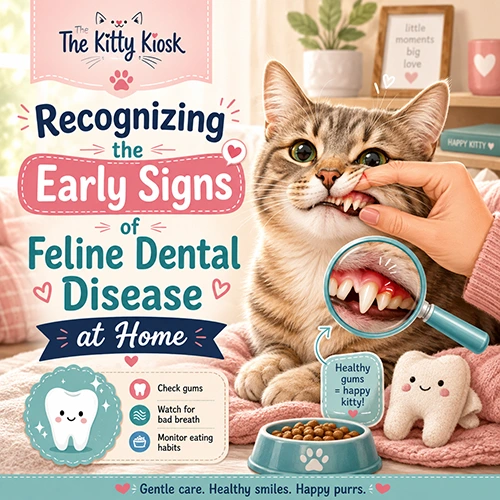
A red line where gum meets tooth. Healthy gum tissue is pale pink and meets the tooth cleanly. A thin, angry red band along that margin is gingivitis, and it is the single most useful thing you can see with your own eyes.
Chewing on one side. Watch for a few seconds at dinner. Food falling out of the mouth, exaggerated head-tilting, or a cat who has quietly reorganized its chewing onto one side is telling you something.
A sudden preference for wet food. A cat who has eaten dry food happily for years and abruptly loses interest is often not being fussy. Kibble hurts. If the switch came out of nowhere, treat it as a clinical sign rather than a preference, and read it alongside our breakdown of what actually separates wet food from kibble before you conclude it is just taste.
Drooling, or pawing at the face. Less common and later, but unmistakable when it happens. Any drooling in a cat deserves attention.
A coat going scruffy. This one gets missed constantly. Grooming requires the mouth. A cat whose fur is looking unkempt along the flanks and back, particularly an older one, may have stopped grooming because grooming hurts. It reads as aging or laziness and it is often a mouth problem in disguise.
The ten-second check
You are not performing an examination. You are lifting a lip and looking at a gumline. Most cats tolerate this fine once it stops being a novelty.
Do one side per session at first if that is all your cat will allow. Rosie needed about three weeks of this before she stopped treating it as an ambush, and now she barely registers it.What you cannot see, and why the vet visit still matters
Here is the limit of home monitoring, and it is a real one.
Resorptive lesions typically begin below the gumline. So do tooth root abscesses and a good share of the damage from advanced periodontal disease. A cat can have a mouth that looks acceptable from the outside and significant pathology underneath, which is why a proper assessment involves dental radiographs under anesthesia rather than a glance during a routine appointment.
That anesthesia requirement is where most owners hesitate, especially with an older cat, and the hesitation is understandable. It is worth knowing that modern feline anesthetic protocols with pre-op bloodwork are considerably safer than their reputation, and that leaving a painful mouth untreated for another two years carries its own substantial cost. Our senior cat care guide covers how to weigh this kind of decision as cats age, and the wider senior health checklist puts oral care in context with everything else that needs watching after ten.
If the appointment itself is the obstacle because your cat becomes unmanageable at the clinic, that is a solvable and separate problem. The techniques in our piece on managing cat anxiety apply directly, and most practices will now prescribe pre-visit medication without much persuading.
Prevention, ranked by how well it actually works
Not all of the options on the shelf carry equal weight, and the gap between the best and the worst is wide.
Brushing is the only approach with strong evidence behind it, and daily beats weekly by a large margin. It is also the hardest sell, so start absurdly small: a finger with a dab of feline paste, touched to one tooth, followed immediately by a treat. Add a tooth at a time over weeks. Cats who accept brushing as adults almost always got there through this kind of glacial progression rather than a determined weekend. The handling principles are the same ones in our grooming walkthrough, and a cat already comfortable being handled is a much easier prospect.
Below that, dental diets with proven mechanical action have moderate support. Dental treats and chews are weaker but not worthless. Water additives sit at the bottom, with the thinnest evidence of anything commonly sold for the purpose.
Whatever you choose, look for the Veterinary Oral Health Council seal. It means the product cleared an actual efficacy standard rather than a marketing meeting, and it is the fastest way to sort a crowded aisle.
The short version
Check the gumline once a week. Trust a change in breath. Treat a sudden switch away from dry food as a symptom rather than a whim. And retire the phrase about them still eating fine, because it has probably delayed more feline dental care than any other sentence in the language.
Loved this post? Explore more cat care tips on our cat blog, or dig into The Golden Years: Senior Cat Care Tips for a fuller picture of what changes as your cat gets older.
About the Author: Milly Brown


Disclosure: This post contains affiliate links. If you purchase through these links, we may earn a commission at no extra cost to you.