
The Golden Years: Senior Cat Care Tips for Your Aging Feline

Has your once spry kitten started to slow down a bit? Maybe they’re sleeping more than usual (even for a cat!), or that jump to the counter isn’t quite as effortless as it used to be. Just like us, our feline friends experience the effects of aging and if your kitty is approaching or past 10 years old, you’ve officially entered the “Senior cat care” parent club. Welcome! It’s a club filled with extra snuggles, deeper bonds, and yes, a few special considerations to keep your aging companion comfortable and happy.
My own tabby, Professor Whiskers, recently celebrated his 12th birthday. While he still has moments of kitten-like playfulness, I’ve noticed him becoming more selective about where he sleeps, how high he climbs, and even which toys capture his interest. These subtle changes prompted me to rethink our home setup and his care routine, and the transformation in his comfort and happiness has been remarkable.
Today, I’m sharing everything I’ve learned about creating a senior-friendly home for your golden-years kitty, from easy environmental tweaks to product recommendations that have made a world of difference for senior cats like the Professor. Because our aging felines deserve all the comfort and care we can provide, don’t they?
Understanding Senior Cat Care & Your Cat’s Changing Needs
The first step in creating an age-friendly home is understanding what’s happening with your cat’s aging body and mind. Around age 10-12 (sometimes earlier for some breeds), cats begin experiencing several changes:
- Reduced mobility and flexibility due to joint stiffness or arthritis
- Decreased vision or hearing that can cause disorientation
- More sensitive digestion requiring dietary adjustments
- Temperature sensitivity (especially feeling the cold more)
- Cognitive changes similar to dementia in humans
Each cat ages uniquely, but being aware of these potential changes helps you spot them early and adapt accordingly. During the Professor’s annual check-up last year, our vet mentioned that over 90% of cats over 12 show some signs of arthritis, though many owners miss these subtle signs, attributing them to “just getting older.”
Easy Home Modifications for Senior Cat Comfort
The good news? Creating a senior-friendly home doesn’t require a complete renovation or huge expense. Here are practical adjustments that make a significant difference:
Access Points Matter
Remember when your cat would leap effortlessly to the top of the bookshelf? Those days might be winding down, but that doesn’t mean they don’t want their favorite perches. Consider:
- Adding stepping stones to favorite high spots (small footstools, sturdy boxes, or dedicated cat stairs)
- Lowering essential resources like food, water, and favorite beds to easily accessible locations
- Creating ramps for key furniture they love (the sofa, your bed, window sills)
When Professor Whiskers started hesitating before jumping to our bay window, his favorite bird-watching spot for over a decade. I placed a small ottoman halfway up. Within minutes, he was back at his post, using the new “step” with a look that clearly said, “Thank you, human, but I totally could have made that jump if I wanted to.” Cat pride never ages!
Comfort Zones: Warmth, Support, and Accessibility
Senior cats need more comfort than their younger counterparts:
- Provide heating options for joints and general comfort (sunny spots, heated beds, warm blankets)
- Increase padding in sleeping areas with orthopedic or memory foam beds
- Create accessible retreats on each floor of your home so they don’t need to navigate stairs
Two months ago, I splurged on a self-warming cat bed with memory foam for Professor Whiskers, placing it in his favorite sunny corner. It’s now his primary napping spot, and I’ve noticed he seems more playful after resting there likely because his joints aren’t as stiff when warm and supported.
Litter Box Considerations
This isn’t the most glamorous topic, but it’s incredibly important. Senior cats may struggle with traditional litter boxes due to arthritis or mobility issues:
- Low entry points are crucial (boxes with at least one very low side)
- More litter boxes throughout the home reduces travel distance
- Larger boxes accommodate less precise movements
- Gentle, unscented litter is kinder to sensitive senior systems
I learned this lesson the hard way when Professor Whiskers had an “accident” near his box. The problem wasn’t behavioral, he simply couldn’t comfortably step over the high sides anymore. Switching to a low-entry box solved the problem immediately.
Cognitive Care: Keeping Their Minds Sharp
Just like humans, cats can experience cognitive decline with age. Signs include disorientation, changed sleep patterns, excessive vocalization, or forgetting learned behaviors like litter box use. Keep their minds active with:
- Gentle environmental enrichment with new textures, smells, and experiences
- Food puzzles adjusted for senior abilities (easier puzzles but still stimulating)
- Consistent routines that provide security and predictability
- Short, gentle play sessions adapted to their energy levels
Professor Whiskers has always been food-motivated, so I’ve switched from his younger-day complex food puzzles to simpler ones that still make him think but don’t require intense manipulation. His favorite is a treat ball with larger openings that dispenses senior dental treats when gently batted around.
Must-Have Products for Senior Cat Comfort
After trying countless products (some hits, some definite misses), here are five game-changers that have significantly improved quality of life for senior cats:
1. K&H Pet Products Thermo-Kitty Cat Bed

This plush, heated cat bed has been Professor Whiskers’ favorite upgrade. The gentle heating only activates when your cat is in the bed, warming to their natural body temperature to soothe achy joints. The orthopedic foam base provides crucial support for aging bodies, and the soft sides give a sense of security that senior cats appreciate.
What makes it special: The bed only warms to 102°F (your cat’s normal body temperature) and uses only 4 watts of electricity, making it safe for 24/7 use. Several cat parents in our community have reported their seniors sleeping more soundly and showing increased mobility after rest.
2. PetSafe CozyUp Pet Stairs

These lightweight but sturdy stairs have made all the difference in allowing the Professor to access his favorite window perch. With non-slip feet and carpet treads for secure climbing, they’re perfect for helping seniors reach beds, sofas, or window sills without dangerous jumping.
What makes it special: The incline is gentler than many other pet stairs, making it easier on arthritic joints. They’re also washable and can be easily moved from room to room as needed.
3. Dr. Elsey’s Senior Cat Litter

This unscented, fine-grain litter is specifically formulated for senior cats. The smaller particles are gentler on sensitive paws, and the excellent clumping makes cleaning easier (important since many senior cats urinate more frequently).
What makes it special: The herbal attractant helps guide seniors who might have memory issues back to their box, while the dust-free formula is easier on aging respiratory systems.
4. Adjustable Cat Ramp with Carpet

For serious mobility issues, this adjustable ramp has been a lifesaver for many senior cats in our community. It can be configured to various heights and features a carpet surface for better grip, helping seniors access beds or other furniture without jumping.
What makes it special: The adjustable height means you can start with a gentle incline and keep the same ramp as your cat’s needs change over time.
5. YingTutu Open Litter Pan with Rim

This simple but effective litter box features an ultra-low entry point while still containing litter well. The rim helps prevent over-the-edge accidents while allowing easy access for seniors with mobility issues.
What makes it special: The balance between accessibility and containment makes this perfect for seniors who struggle with traditional boxes but still have good litter habits.
Cat Age Chart
Cat Age to Human Age Chart
A more accurate way to understand your cat’s age in human years
| Cat Age (Years) | Human Age Equivalent | Life Stage |
|---|---|---|
| 1 | 15 | Young Adult |
| 2 | 24 | Adult |
| 4 | 32 | Adult |
| 6 | 40 | Mature Adult |
| 8 | 48 | Mature Adult |
| 10 | 56 | Senior |
| 12 | 64 | Senior |
| 14 | 72 | Geriatric |
| 16 | 80 | Geriatric |
| 18 | 88 | Geriatric |
| 20 | 96 | Geriatric |
Note: Cats enter their senior years around 10-12 (equivalent to humans in their mid-50s to 60s).
Recognizing Pain and Discomfort
One of the biggest challenges with senior cats is that they’re masters at hiding pain. After all, showing weakness in the wild would make them vulnerable. As responsible cat parents, we need to become detectives, looking for subtle signs:
- Decreased grooming or matted fur
- Changes in litter box habits
- Reluctance to jump or climb
- Irritability when touched in certain areas
- Sleeping more than usual
- Postural changes or stiffness when walking
The most heartbreaking realization I had with Professor Whiskers was understanding that his decreased play and interaction wasn’t just “getting old”, he was actually experiencing discomfort. After working with our vet on a joint supplement regimen, the change in his demeanor was remarkable. He didn’t become a kitten again, but his comfort and quality of life improved dramatically.
Important reminder: Always consult your veterinarian about any changes in behavior or routine. While aging is natural, pain and suffering shouldn’t be considered an inevitable part of getting older.
The Emotional Side of Senior Cat Care
There’s something truly special about caring for a senior cat. The relationship deepens in these golden years, a quiet understanding develops between you and your aging companion. They may not chase the laser pointer with the same abandon as before, but that gentle head-bump as you sit together speaks volumes about your bond.
Caring for Professor Whiskers in his senior years has taught me patience, empathy, and to appreciate the quiet moments. While I sometimes miss his wild kitten antics, our relationship has evolved into something more profound. He’s become more vocal (especially at 3 am!), more affectionate, and seems genuinely grateful for the accommodations that make his life easier.
Remember that these adaptations aren’t just about physical comfort, they’re about dignity. Our senior cats have given us years of companionship, entertainment, and unconditional love. Making these simple changes helps them navigate aging with grace and comfort.
Senior Cat Care Final Thoughts: Embracing the Golden Years
Creating a senior-friendly home isn’t complicated, but it does require attention and empathy. By making these relatively simple adjustments, you’re not just improving your cat’s physical comfort, you’re honoring the special relationship you’ve built over the years.
The gray whiskers, the slower pace, the extra naps, they’re all part of the beautiful journey of sharing your life with a cat through all their stages. And trust me, there’s something extraordinarily rewarding about seeing your senior cat contentedly snoozing in their heated bed or successfully navigating their new steps to a favorite perch.
What adjustments have you made for your senior kitty? Have you found products or solutions that have made a significant difference? Share your experiences in the comments below, your insights might help another cat parent whose feline friend is just entering their golden years.
Because every cat deserves to age with dignity, comfort, and all the love we can possibly give them. After all, they’ve spent years perfecting the art of wrapping us around their little paws, the least we can do is make their golden years as golden as possible!
Remember: While these adjustments can significantly improve your senior cat’s quality of life, they don’t replace proper veterinary care. Regular check-ups become even more important in the senior years, so partner with your vet to create a comprehensive care plan for your aging feline friend.
Loved this post? Explore more helpful cat care tips on our cat blog and join our community of cat lovers to share stories and advice!
About the Author: Milly Brown

A quick heads up
Some links in our posts are affiliate links. If you buy through one, we may earn a small commission at no extra cost to you. How it works
Shop the aisles
Hand-picked, well-reviewed gear for every kind of cat.
How old is your cat in human years?
Our free calculator works it out in seconds. No math, no judgment.
Fresh off the blog

Lost cat? What to do in the first 24 hours (an hour-by-hour plan)
It usually starts with something small. The back door didn’t quite latch. The screen had a corner pulled loose. A delivery driver stood in the doorway a beat too long. Then the house goes quiet in a way you notice before you understand it, and you start calling a name that doesn’t answer.
If that is where you are right now, take one breath and read the next two sections. They matter more than anything else on this page.
We wrote this as a plan you can follow hour by hour, because panic makes everybody search in the wrong places. The good news is that the odds are on your side when you do the right things early.
The first hour: search close, slow, and quiet
Start inside. Seriously. A frightened cat can wedge itself into places you would swear are too small: inside a recliner, under the springs of a bed, behind the dryer, in the back of a closet, or up inside a kitchen cabinet with a gap at the top. Rosie’s go-to hiding spot is the space behind our bed, and she has ignored her own name from back there for the better part of an hour. Open every cabinet and closet, and use a flashlight.
Once you are sure the house is empty, go outside, but slow down. Lost cats are rarely running down the street. Far more often they are tucked under something within a few houses of home, silent and frozen, hoping nobody finds them.
A 2018 study of missing cats published in the journal Animals found that indoor-only cats were usually found very close to where they got out, and that physically searching the neighborhood found more cats than any other method. Cats that are used to going outside tend to travel farther, but even they rarely go as far as owners fear.
Walk the area slowly and look low: under porches and decks, beneath parked cars, inside bushes, along fence lines, and in window wells. Call in a normal, calm voice, then stop and listen for a full minute. A scared cat may answer with a tiny sound or not at all, and it will not come running toward a stranger’s voice or yours if you sound upset.
Hours one and two: knock on doors and ask for camera clips
Your neighbors are your best search party, and most of them will be glad to help if you ask directly.
Knock on every door within a few houses on each side and across the street. Show a photo on your phone and ask two specific things. First, can they check their garage, shed, and basement? Cats slip into open garages and get shut in all the time, and that is one of the most common places lost cats turn up. Second, do they have a doorbell or yard camera?
That second question is the one people forget. Ring, Blink, Nest, and other cameras record motion all night, and a cat crossing a driveway at 2am is exactly the kind of thing they catch. Ask neighbors to scroll back through the clips from the time your cat went missing. A single screenshot can tell you which direction to search.
Hours two to four: posters up, and post online
Paper posters still work, because the people most likely to spot your cat are the ones who walk and drive past your street every day. Keep the design simple enough to read from a moving car: “LOST CAT” in huge letters, one clear photo, your cat’s name, where and when they were last seen, and a phone number in large print.
You can make one in a couple of minutes with our free lost cat poster maker. It builds a printable poster with tear-off phone tabs plus a square image sized for social media, and you do not need an account.
Put posters up within a few blocks first: mailbox clusters, intersections, bus stops, school crossings, and the entrances to parks. Then widen out to vet clinics, pet stores, and community boards at grocery stores and laundromats.
Online, share the square image in your local Facebook lost-and-found pet groups and on Nextdoor. You can also give your cat a free listing on our Lost Cat Board, which puts them on a map, lets neighbors post sightings and camera screenshots, and emails you the moment someone does. It also adds a QR code to your poster, so anyone who sees it on a pole can report a sighting from their phone.
Hours four to eight: shelters, vets, and the microchip
Call your local animal shelter, animal control, and any nearby rescues. Then call vet clinics and the closest emergency vet, in case a good Samaritan brings in an injured cat. Give each one a description, your phone number, and ask how they log found animals.
Then go in person. Descriptions over the phone get missed (“gray cat” covers half the cats in a shelter), and stray hold periods can be short, sometimes only a few days depending on where you live. Plan to visit every couple of days, not once.
If your cat is microchipped, call the microchip company today. Confirm the chip is registered to you and that the phone number on file is current; an out-of-date number is one of the most common reasons a scanned cat does not make it home. If you are not sure which company holds the record, the AAHA Universal Pet Microchip Lookup at petmicrochiplookup.org can tell you.
After dark: the best search window of the day
This is the part most people skip, and it is often when cats are found. Once the street goes quiet, a hiding cat feels safe enough to move, and a flashlight makes their eyes shine back at you from under decks and hedges.
Go out around dusk, then again late at night and at first light. Walk slowly, stop often, and call softly. Shake a treat bag or tap a food can with a spoon if that is a sound your cat knows. If you spot them, resist the urge to grab. Sit down, look away, talk quietly, and let them come to you, even if it takes twenty minutes.
Back at home, leave something that smells like you and like them near the door they got out of: a worn T-shirt, their bed, or a blanket they sleep on. If the trail goes cold, ask your shelter or a local rescue about borrowing a humane trap. They are safe, and they catch cats who are too frightened to come to anyone.
Day two and beyond: keep going
If the first day ends without your cat, you have not failed. Cats are found weeks and even months after they go missing, often because a poster finally reached the right person or a shy cat finally got hungry enough to come out.
Keep visiting shelters in person. Refresh your online posts every few days so they stay near the top of local groups. Replace posters that have faded or blown down. Post updates on your listing when you learn something new, like a sighting a few streets over, so the people following along know where to look.
When they come home
Book a vet check, even if your cat seems fine. A few days outside can mean dehydration, small wounds, or fleas you will not spot right away.
Then take the next step to make it less likely to happen again. Make sure your cat has a microchip with up-to-date details and a breakaway collar with an ID tag carrying your phone number, which is the fastest way a neighbor can reach you. If your cat is a door-dasher, our look at GPS and Bluetooth trackers for cats covers the options. For cats who clearly want more of the outdoors, these safe indoor and outdoor compromises can take the pressure off the front door.
And if your cat goes outside regularly, our guide to outdoor cat safety covers the hazards that catch most owners off guard. Trips are another common time for escapes, so our tips for traveling with your cat are worth a look before the next car ride.
Lastly, if you listed your cat on the Lost Cat Board, mark them as found. It lets everyone who helped know the good news, and every happy ending gives hope to the next person standing in their driveway calling a name.
Loved this post? Explore more cat care tips on our cat blog, or dig into Outdoor cat safety: the five threats people forget about for a deeper look at keeping your cat safe beyond the front door.
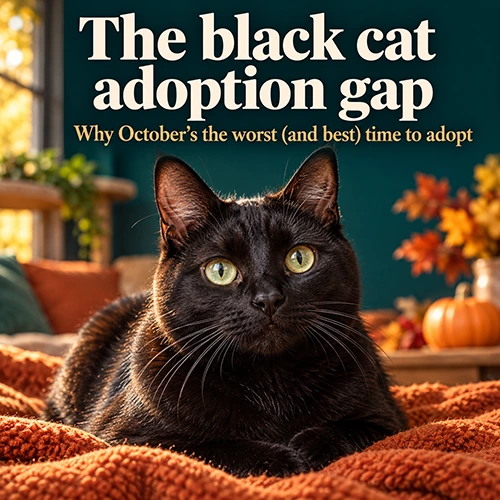
The black cat adoption gap: why October’s the worst (and best) time to adopt
Walk into a busy shelter and look at the cat room. The orange tabby by the door is getting three visitors at once. The calico is doing her best impression of a loaf in the front window. And somewhere in the back row, a black cat is sitting very still, watching everyone walk past.
That scene is familiar to a lot of shelter volunteers. Whether these cats really get adopted less often is a more complicated question than the internet tends to admit, but there is enough evidence of a real bias to take it seriously. And October, the month that leans hardest on the spooky black cat stereotype, turns out to be one of the best times to push back on it.
What the research actually says
The honest answer is that the picture is mixed. Here is what we know.
An often-cited study of one California shelter, published in 2002, found that black cats had lower adoption rates than cats of most other colors. Later research on why that might happen points to perception. In a 2019 study, psychologists showed people photos of cats in different colors and found that black cats were more often rated as less friendly and harder to read. People who scored higher for superstitious beliefs were more likely to show that bias.
On the other hand, data from some large shelter networks has not found a big gap in adoption rates by color. Results seem to vary from shelter to shelter and region to region. So rather than a universal rule, think of it as a real tendency that shows up in some places more than others.
Why black cats can get overlooked
Even without any superstition involved, a few practical things work against them.
They are hard to photograph
Most people now find their next pet online before they ever visit a shelter. A dark-coated cat in a dim kennel, shot on a phone, often turns into a dark shape with two glowing eyes. You lose their expression, the shape of their face, and any sense of personality. Shelters that have improved their photography, using better lighting and brighter backgrounds, often report that black cats get more interest as a result.
Their faces are harder to read
Much of what we read in a cat’s expression comes from contrast: the shape of the eyes, the angle of the ears, small changes around the whiskers. On a solid black face, those cues blend together. People are not wrong that black cats can be harder to read at a glance. They are wrong about what that means. It says nothing about personality.
There are simply more of them
Black is one of the most common coat colors in domestic cats. When a shelter has eight of them and one Siamese mix, the eight can look interchangeable to a casual visitor, while the Siamese stands out. Any one black cat ends up competing mostly with other black cats.
The Halloween adoption ban, and why most shelters dropped it
For years, some shelters paused black cat adoptions in the weeks before Halloween. The fear was that people might adopt them as props for parties or costumes, or that they could be harmed by people acting on superstition.
There is very little evidence that this was ever a common problem. Many shelters have since dropped the policy, and some now do the opposite, running special adoption events for them in October. The reasoning is simple. Keeping cats in the shelter for weeks based on a rare risk costs them weeks of being in a home, and it reinforces the idea that black cats are somehow spooky.
That said, it is still sensible to keep any cat, black or otherwise, indoors around Halloween. The real risks that week are ordinary ones: traffic, noise, and open doors. Our guide to the outdoor threats people forget about covers those in more detail.
Why October is a great month to adopt one
Here is the twist. The month most associated with the scary black cat stereotype is also when shelters and rescues are most likely to celebrate them. Black Cat Day falls on October 27, and many groups run reduced-fee or fee-waived adoption events around it. If you have been thinking about adopting, this is a good time to look.
It is also a good time to look at the cats people walk past for other reasons: seniors, shy cats, cats with a medical history. Our notes on caring for an older cat are a good read if a gray-whiskered black cat catches your eye.
When you meet a cat in person, give them a few minutes before you decide anything. Sit down at their level, let them come to you, and watch how they respond to a slow blink or a hand held out to sniff. A black cat who seemed aloof in a listing photo often turns out to be the one headbutting your knee five minutes later. Shelters are noisy, stressful places, and nobody shows their best self in a kennel.
What living with a black cat is actually like
There is no good evidence that coat color predicts personality in any meaningful way. These cats are as varied as any other group: lap cats, chatterboxes, troublemakers, and quiet observers. Personality comes from genetics, early socialization, and individual experience, not from the color of the fur.
What you do get is a few practical quirks. They can be nearly invisible at night, so you will learn to shuffle your feet in a dark hallway. Their fur shows up on light furniture and vanishes on dark clothing. Some black cats develop a reddish or rusty tint in strong sunlight as they age, which is normal. And they are, almost without exception, impossible to photograph well on the first try. Expect a camera roll full of dark blurs with two glowing eyes.
If you do bring one home, the first weeks matter more than the color. Our guide to introducing a new cat to your home walks through the settling-in process step by step, and the first-time cat parent essentials list covers the gear.
How to help even if you cannot adopt
Not everyone is in a position to bring home a cat this month. There are still ways to help close the gap:
- Volunteer to take photos. If you have a decent camera and some patience, shelters will be thrilled. Bright, even light and a colorful background make a huge difference for a dark coat.
- Share listings. A good photo, shared on social media with a line about their personality, can find them a home.
- Foster. A cat in a foster home can be photographed relaxed and playing, which shows off a personality a kennel photo never could.
- Donate to fee-waived events. Many rescues rely on sponsors to cover the cost of reduced-fee adoption days.
Black cats are not unlucky, and they are certainly not spooky. Sometimes they are just harder to see. This October, take a second look at the back row.
Loved this post? Explore more cat care tips on our cat blog, or dig into the story of NYC’s bodega cats for another look at cats people tend to overlook.
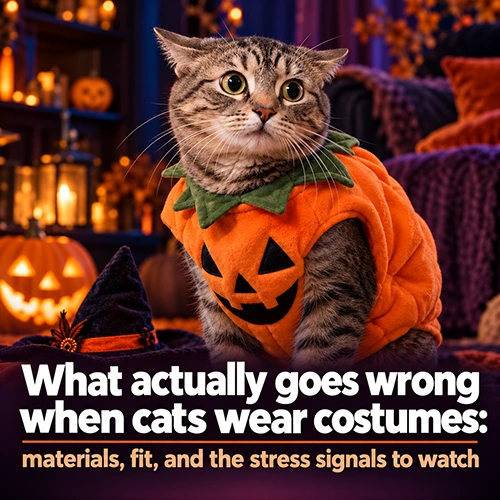
What actually goes wrong when cats wear costumes: materials, fit, and the stress signals to watch
The photo always looks the same. A cat in a pumpkin suit, or a tiny witch hat, or a lion’s mane, sitting perfectly still and staring into the camera. People see that stillness and assume the cat is fine with it.
Often, the cat is not fine with it. They are frozen.
We are not here to ban cat costumes. A lot of people enjoy them, and some cats genuinely tolerate a light outfit for a quick photo. But it helps to know what actually goes wrong, why cats react the way they do, and which kinds of costumes cause the most trouble. That way, if you do dress your cat up this Halloween, you can do it in a way that is fast, safe, and as low-stress as possible.
Why cats and costumes are a bad match
Dogs have been bred for thousands of years to work closely with people, and many of them tolerate clothing well. Cats are a different story. A few things about how they are built make costumes harder for them.
- Their skin and coat are sensitive. Cats rely on touch to understand their surroundings. Fabric pressing on their back, chest, or legs is a constant, unfamiliar signal they cannot switch off.
- Their whiskers are sensors. Whiskers help cats judge space and detect movement nearby. Anything that bends or covers them, like a hood or mask, can be genuinely disorienting.
- They hate losing control of their movement. Cats move with precision. Clothing that pulls on their legs or shifts as they walk can make them feel restricted and off balance.
- Their ears are emotional signals. Hats and headbands pin down the ears, which cats use for communication. It is a bit like having someone hold your face still while you try to talk.
The freeze, the flop, and other stress signals
The most common reaction to a costume is not panic. It is stillness. Many cats freeze when they feel restrained, and in photos that freeze reads as calm. It is better understood as a cat waiting for the uncomfortable thing to be over.
Other signs your cat is not enjoying their outfit:
- Flopping onto their side and refusing to walk.
- Walking low to the ground in a crouch, or backing up.
- Ears flattened or turned sideways.
- Wide eyes with large pupils.
- A tail that is tucked, puffed, or thrashing. Our guide to what your cat’s tail is telling you covers the full vocabulary.
- Licking their lips, or excessive grooming once the costume is off.
- Trying to wriggle out, bite, or scratch at the outfit.
The materials that cause the most trouble
Not all costumes carry the same risk. These are the features most likely to cause problems:
Elastic around the neck or chest
Tight elastic can restrict breathing and movement, and it can rub the skin raw. If a costume relies on elastic straps to stay on, it is probably too tight for a cat. Cats are also very good at getting a leg caught in a loose strap, which can be just as dangerous.
Small parts and dangling decorations
Buttons, pom-poms, sequins, bells, and loose threads are all chewable, and many are small enough to swallow. String, ribbon, and elastic cords are especially dangerous, because cats who swallow them can end up with a serious intestinal blockage that may need surgery.
Heavy or synthetic fabrics
Cats already wear a fur coat. Thick polyester costumes and plush full-body suits can trap heat, especially in a warm house full of people. Overheating is uncommon, but it is possible, and the stress of the costume adds to it.
Anything with dye, paint, or glitter
Cats groom constantly, so anything on their fur ends up in their mouth. Never use face paint, hair dye, colored spray, or glitter on a cat. Even products labeled “pet-safe” are usually designed for dogs.
Fit: how to tell if a costume is safe
If you are going to try a costume, the fit matters more than the design. A good fit for a cat looks like this:
If a costume fails any of these, skip it. A simple outfit that fits well is safer than an elaborate one that almost does.
Some cats really do not mind
To be fair to the costume fans, there are cats who handle a light outfit well. They tend to be the ones who were handled a lot as kittens, who already wear a harness for walks, or who are simply laid back about everything. If your cat walks, plays, and eats normally with a costume on, keeps their ears in a relaxed position, and does not try to remove it, a short session is probably fine.
Even then, the same rules apply. Keep it light, keep it brief, and stay close. Tolerance on Tuesday is not a guarantee on Saturday, especially with a doorbell going.
How to do a costume photo the low-stress way
If your cat seems reasonably relaxed about being handled, a quick photo can be done safely. Keep it short and on their terms.
Start by letting your cat sniff and investigate the costume on the floor for a day or two before you put it on. Have treats ready and a second person to take the photo. Put the outfit on, take a few shots quickly, then take it off. Aim for under a minute or two. Do not try for the perfect picture. Take what you get.
Rosie made her opinion on this extremely clear years ago. We tried a small bat-wing harness, she flopped onto her side like a fainting goat, and that was the end of her costume career. She has since been allowed to supervise the decorating from a safe distance, which suits everyone.
Costume ideas that skip the cat entirely
The best costume for most cats is no costume at all. If you still want a themed photo, there are other ways to get it:
- Dress the space. Put your cat’s bed in a cardboard “haunted house” or decorate their favorite box with paper bats.
- Use a photo prop. A small witch hat placed next to the cat, rather than on them, often gets the same laugh.
- Edit it in. Plenty of phone apps add costumes to a photo after the fact. Your cat will never know.
- Match your cat instead. Dress yourself up. Our cat-themed tees are a lot easier to wear than a pumpkin suit is for a cat.
If your cat is the anxious type, Halloween night has plenty of other stressors to manage. Our guide to recognizing cat anxiety will help you read the signs, whether or not a costume is involved.
Loved this post? Explore more cat care tips on our cat blog, or dig into Understanding Your Cat’s Behavior for a deeper look at the instincts behind how cats react to the world.
Your turn
Leave a comment
Tried this with your own cat? Tell us how it went. We read every comment.
You must be logged in to post a comment.
Keep reading
More from the Kiosk
Your cat is asleep on something important. Plenty of time for one more.

How to Introduce a New Cat to Your Home (and Existing Pets)
Listen to the audio version of this blog post to enjoy our insights and tips on the go—perfect [...]

Feline Foodie: Gourmet Homemade Cat Treats You Can Make at Home
Listen to the audio version of this blog post to enjoy our insights and tips on the go—perfect [...]

The Rising Trend of Collar Cameras & How Your Feline Could Be the Next Social Media Star
Have you ever wondered what your cat gets up to when they slink away through the cat flap or [...]
Still curious?
[…] of in it, which is one of the most telling patterns there is. If your cat is over ten, our notes on caring for an aging cat cover the other quiet changes that arrive around the same […]