

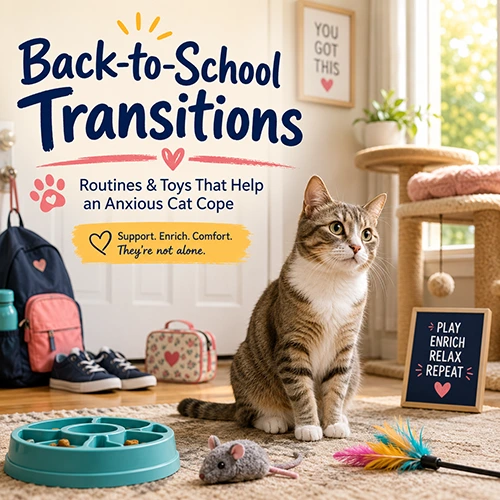
Back-to-school transitions: the routines and toys that help an anxious cat cope
Table of Contents
The house is loud until 7:40am. Cereal bowls, backpack panic, somebody shouting about a permission slip, the door, the car, and then nothing.
Not quiet. Empty. There is a difference, and your cat can hear it.
For a few weeks in late August the household your cat has been living in reorganizes itself completely. The people who were around all summer leave at the same time every morning, the noise level drops off a cliff, and the schedule that had been improvised since June suddenly runs like a train timetable. Some cats do not notice. Plenty of others start doing something new around the second week, and their humans do not connect it to the calendar.
Cats do get separation distress. It just wears a disguise.
The old line was that cats are solitary and do not much care who is home. That has aged poorly. Domestic cats form real attachments to the people they live with, and a share of them show measurable distress when those people go.
The reason it gets missed is that a distressed cat does not do the obvious thing. A dog paces, howls, and chews the doorframe. Cats mostly go quiet and internal, and the signal arrives as something that looks like an unrelated problem: a litter box lapse, a bald patch, a cat who stops eating until somebody comes home. Owners take those to the vet as separate complaints, which is exactly the right move, but the timing goes unmentioned.
What shows up in the first two weeks
Watch for changes rather than absolutes. A cat who has always been vocal is not telling you anything new by being vocal.
- Over-grooming. Usually the belly, inner thighs, or one flank. Thinning fur before bald skin, and it is often mistaken for allergies.
- Box trouble. Especially on a bed, a couch, or a pile of clothing belonging to the person who left. That location is not an accident.
- Food refusal while alone. The bowl sits untouched all day and gets cleared out the second the front door opens.
- Departure-side clinginess. Following you room to room during the getting-ready window, then a fixed spot by the door.
- The overwhelming reunion. Frantic greeting, sustained yowling, and a cat who will not settle for the first half hour.
- Sleeping through the day and prowling at night. A schedule flipped by a house that is now interesting only after dark.
Any one of these on its own is worth a vet conversation first, because over-grooming and box lapses both have solid medical explanations. If the exam is clean and the timing lines up with the school run, you are looking at an adjustment problem. Our piece on the signs of anxiety in cats covers the wider vocabulary.
Start the change before the change
If school has not started yet, or if you are reading this during the first week, you can still stagger it.
Practice the departure. Get dressed, pick up the keys, go out the front door, and come back in ninety seconds. Do it again an hour later. Then five minutes. Then twenty. What you are teaching is that the keys and the door do not reliably mean six hours of nothing.
Move the feeding times to where they will be during term time, and do it a few days early. Meals are the strongest anchor in a cat’s day, and shifting them is more disruptive than shifting anything else.
If summer involved a lot of daytime lap time, taper it deliberately. Going from constant company to none in one step is the version that produces the bald patch.
Make the goodbye boring and the empty house interesting
This is the part people get backward, usually out of guilt.
The ten minutes that matter most
A hard play session before you leave beats a long cuddle every time. Ten to fifteen minutes with a wand toy, ending with a catch your cat actually wins, then breakfast. Hunt, eat, groom, sleep is the natural sequence, and a cat who has run it properly at 7:30 is asleep by 8:00 instead of listening to the silence.
Give the absence a job
Do not put breakfast in a bowl on a school morning. Put it in a puzzle feeder, or split it across three or four hiding spots at different heights so the morning includes a small foraging expedition. A timed feeder that clicks open at 1pm gives the middle of the day a landmark. Rotate toys weekly rather than leaving everything out, because eight toys on the floor permanently is functionally zero toys.
Windows, height, and something to watch
A sunny window with a perch and a bird feeder outside it does more for a bored indoor cat than most things you can buy. Vertical space matters too. Cats who can get up high have more territory to patrol without more square footage. Leaving a radio or a talk podcast on low helps some cats and does nothing for others, so try it for a week and watch.
The reunion is where the good work gets undone
Everybody comes home at 3:30 and the cat gets mobbed. Two kids, a backpack on the floor, and a lot of high-pitched enthusiasm aimed at an animal who has been asleep for six hours.
Try the opposite. Come in, put things down, ignore the cat for five minutes, and let them come to you. Then run the second play session of the day, and keep it at roughly the same time. What you are building is a predictable shape to the afternoon, which is worth more to a cat than any single burst of affection.
It is also worth agreeing on some house rules with younger kids. No picking the cat up off the floor, no following them under the bed, and the cat gets to leave a room whenever the cat wants. Rosie has a spot on top of the bookshelf that everyone in our house treats as off limits, and that one rule has prevented more trouble than any product ever has.
When it is not an adjustment problem
Give the new routine two to three weeks. Most cats settle into it.
If the behavior is still there after a month, or it is escalating, ask your vet about it directly. Pheromone diffusers help some households, and for genuine separation anxiety there are medications worth discussing. Neither is a substitute for the routine work, but neither is a failure either.
Toys that carry a quiet house
Two categories earn their keep during the school year: something that dispenses food for the empty hours, and something on a stick for the ten minutes at each end of the day. Puzzle feeders slow eating, occupy a brain, and turn one meal into a twenty minute project. Wand toys let you run a proper hunt without your hand becoming the prey.
Solo toys matter less than people think, but a small rotating set keeps the middle of the day from being featureless. Our picks for interactive cat toys covers what has held up, and the rest of the toy shelf is worth a browse if you are building out a rotation.


The whole thing comes down to one idea. Your cat is not upset that you left. Your cat is unsettled that the shape of the day changed without warning. Give the new shape some structure and most of this sorts itself out by October.
Loved this post? Explore more cat care tips on our cat blog, or read Understanding Your Cat’s Behavior for more on what the everyday signals mean.
About the Author: Milly Brown


Disclosure: This post contains affiliate links. If you purchase through these links, we may earn a commission at no extra cost to you.