
The Top 10 Most Famous Cats in History: Tales of Whiskered Legends

Cats have been captivating humans for centuries, leaving their pawprints not just on our hearts but also in history, pop culture, and even politics. From heroic deeds to internet fame, these feline celebrities have carved their niche in human memory. Whether you’re a cat enthusiast or just curious about the illustrious lives of famous kitties, this list will whisker you away on a journey of feline greatness.
The Kitty Kiosk have put together a list of the Top-10 most famous cats in history. So let’s get our claws stuck in and meet the superstars of the kitty world!
The Top-10 Most Famous Cats List
1. Felix the Cat: The Silent Film Star

Felix the Cat is one of the earliest animated characters in history, debuting in silent films during the 1910s. Created by Pat Sullivan and Otto Messmer, Felix’s mischievous adventures and iconic grin made him a household name. His magic bag of tricks allowed him to navigate various escapades, delighting audiences worldwide.
Felix was a trailblazer in the animation industry, paving the way for characters like Mickey Mouse. His popularity extended to merchandise, comic strips, and even a television series in the 1950s. Despite being nearly a century old, Felix remains a beloved cultural icon.
Fun Fact: Felix was so popular that his image graced clocks, toys, and even airplane noses during WWII.
2. Socks: The First Cat of the United States

Socks, a black-and-white tuxedo cat, moved into the White House in 1993 with the Clintons. Adopted as a stray in Arkansas, Socks quickly became a beloved member of the First Family. He often accompanied Hillary Clinton during public appearances and was even featured in a video tour of the White House.
Socks had his own fan mail and even a website, showcasing his popularity during the early days of the internet. However, he didn’t get along with Buddy, the Clintons’ Labrador Retriever, leading to some amusing headlines. After leaving the White House, Socks retired to a quieter life with Clinton’s secretary, Betty Currie, living out his days with dignity until his passing in 2009.
Why We Love Him: Socks was proof that shelter cats can become stars, rubbing whiskers with world leaders and still holding down the fort as a loving family pet.
3. Grumpy Cat: The Internet’s Ultimate Meme Machine

Grumpy Cat, whose real name was Tardar Sauce, became an internet sensation in 2012 thanks to her perpetually “grumpy” expression. Born with feline dwarfism, her unique appearance was the result of an underbite and genetic quirks. Her grumpy visage turned her into a meme icon, symbolizing everyday frustrations with captions like “I had fun once—it was awful.”
Beyond memes, Grumpy Cat became a media empire. She starred in commercials, had her own book, and even featured in a holiday movie titled Grumpy Cat’s Worst Christmas Ever. Despite her fame, Tardar Sauce remained a sweet and loving pet, as her owner often reminded fans. She passed away in 2019 but remains one of the most recognizable cats in internet history.
Legacy: Grumpy Cat earned an empire of merchandise, books, and even a movie, proving that being a grump pays off.
4. Maru: The King of Boxes

Maru, a Scottish Fold from Japan, gained worldwide fame for his obsession with boxes. His YouTube channel, launched in 2008, features videos of Maru squeezing into boxes of all shapes and sizes, often in hilariously impractical ways. With millions of views, Maru became a global ambassador for cats’ inexplicable love for cardboard.
Maru’s charm lies in his persistence and ingenuity. Whether attempting to fit into a tissue box or a suitcase, his antics showcase the curious and determined spirit of cats. Maru’s videos continue to delight fans, making him one of the most celebrated internet cats of all time.
Why It Works: Maru’s antics remind us of every cat’s inexplicable obsession with cardboard, no matter how illogical it seems.
5. Salem Saberhagen: The Sassy TV Cat

Salem Saberhagen, the sarcastic and witty black cat from Sabrina the Teenage Witch, became a fan favorite in the 1990s. Voiced by Nick Bakay, Salem was a 500-year-old witch sentenced to live as a cat as punishment for trying to take over the world. His scheming personality and humorous one-liners added a touch of comedic brilliance to the show.
Salem’s character resonated with viewers for his mix of mischief and wisdom. Though he was portrayed by both animatronics and real cats, it was his snarky dialogue that made him unforgettable, cementing his place in pop culture history.
Standout Moment: His love for plotting world domination—paired with his inability to open a tuna can—made him a relatable anti-hero.
6. Scarlett: The Brave Rescue Cat

Scarlett, a stray cat in Brooklyn, New York, became a global symbol of maternal devotion in 1996 when she rescued her five kittens from a burning garage. Suffering severe burns to her face and body, Scarlett painstakingly carried each kitten to safety, despite being gravely injured herself.
Scarlett’s incredible bravery earned her widespread recognition, including an animal hero award from the North Shore Animal League. Her story inspired countless people, and her recovery was followed by fans worldwide. Scarlett lived out her life in a loving home and remains an enduring symbol of courage and the fierce love of a mother.
Heartwarming Detail: Scarlett’s story inspired donations to animal rescue organizations and highlighted the power of a mother’s love.
7. Larry: The Chief Mouser of Downing Street

Larry, a tabby cat, has served as the Chief Mouser to the Cabinet Office at 10 Downing Street since 2011. Rescued from Battersea Dogs & Cats Home, Larry’s primary role is to control the rodent population in the British Prime Minister’s residence. However, he’s also known for his interactions with world leaders and the media.
Larry’s personality has made him a media darling. From photobombing press conferences to his “feuds” with other Downing Street pets, Larry has brought charm and relatability to the political sphere. He remains a symbol of resilience and the importance of adopting rescue animals.
Why He Stands Out: Larry’s no-nonsense attitude and knack for stealing the spotlight during press conferences have made him a national treasure.
8. Hello Kitty: The Global Icon

Hello Kitty, while technically not a real cat, has become one of the most famous feline-inspired characters in history. Created by the Japanese company Sanrio in 1974, Hello Kitty’s simple design and cheerful demeanor captured the hearts of millions. She is often associated with themes of friendship and kindness.
Hello Kitty’s empire spans everything from stationery and clothing to theme parks and even airplanes. While some fans are surprised to learn that Hello Kitty is depicted as a girl rather than a cat, her enduring appeal has made her a global ambassador of “kawaii” (cute) culture.
Fun Fact: Hello Kitty doesn’t have a mouth, symbolizing that she speaks from the heart rather than words.
9. Hamish McHamish: Scotland’s Beloved Cat

Hamish McHamish, a long-haired ginger cat from St. Andrews, Scotland, was a local celebrity known for his wanderlust. Unlike most cats, Hamish didn’t belong to a single home—instead, he was cared for by the entire town. From cozying up in university offices to lounging in cafes, Hamish’s friendly nature made him a cherished community member.
In 2014, a bronze statue of Hamish was erected in St. Andrews to honor his impact on the town, funded by residents and admirers from around the world. Hamish passed away later that year, but his statue continues to attract visitors, ensuring his legacy as Scotland’s most beloved feline ambassador.
Why We Love Him: Hamish embodied the spirit of independence, proving that a cat’s home isn’t a single house—it’s wherever they’re loved.
10. Stubbs: The Cat Mayor

Stubbs, a ginger tabby cat, earned international fame as the honorary mayor of Talkeetna, Alaska, in 1997. While his position was largely symbolic, Stubbs’ charm made him a beloved figure in the small town of fewer than 1,000 residents. His duties included greeting locals and tourists at the general store, where he would sip water from a wine glass filled with catnip.
Stubbs’ story is a testament to how unconventional leaders can inspire communities. Despite a rough encounter with a dog that left him injured in 2013, Stubbs continued to fulfill his mayoral duties until his passing in 2017 at the age of 20. His legacy lives on, with visitors still flocking to Talkeetna to learn about the charismatic cat who captured the world’s heart.
Purr-spective: Stubbs held his honorary title for 20 years, showing that sometimes, the best politicians have whiskers.
Why Do Cats Captivate Us So Much?
Cats possess an extraordinary blend of independence, mystery, and undeniable charm that has fascinated humans for centuries. Unlike dogs, whose loyalty is often boisterous and overt, cats intrigue us with their subtle, almost enigmatic ways of showing affection. They can be aloof one moment and irresistibly cuddly the next, leaving us continually guessing—and utterly captivated.
Their history as companions dates back to ancient civilizations, where they were revered as symbols of protection and prosperity. Even today, cats continue to embody a unique duality: they’re both wild and domesticated, playful yet reserved. This mix of traits is a big part of what makes them so universally appealing.
What’s more, cats’ ability to fit seamlessly into so many different roles—hero, celebrity, or even mayor—demonstrates their incredible versatility. They don’t conform to societal expectations, yet they often find themselves at the center of our cultural narratives. Their antics entertain us, their quirks inspire us, and their resilience often humbles us. Simply put, cats have mastered the art of being unforgettable.
For cat lovers, these furry companions aren’t just pets—they’re little enigmas, endlessly fascinating in their ability to adapt, charm, and leave a lasting impression. Whether it’s a cat curling up in a sunbeam or pulling off a daring rescue, they remind us of the beauty in life’s small, unexpected moments.
Final Thoughts – The Top-10 Most Famous Cats
The stories of these famous cats remind us why we love our own furry companions so much. They’re quirky, brave, and sometimes downright hilarious. Whether your cat aspires to Grumpy Cat’s fame or Stubbs’ political career, they’ll always be the star of your heart.
Which famous cat is your favorite? Share your thoughts in the comments or join our growing community of cat lovers to discuss the amazing lives of these whiskered legends!
Want more feline fun? Be sure to check out our other epic cat-inspired posts on our cat blog. From heartwarming tales to expert tips, there’s something for every cat lover. Don’t forget to join our cat community, where we share stories, tips, and tricks about our beloved fur babies. Together, we’re building the ultimate haven for cat enthusiasts!
About the Author: Milly Brown

A quick heads up
Some links in our posts are affiliate links. If you buy through one, we may earn a small commission at no extra cost to you. How it works
Shop the aisles
Hand-picked, well-reviewed gear for every kind of cat.
How old is your cat in human years?
Our free calculator works it out in seconds. No math, no judgment.
Fresh off the blog
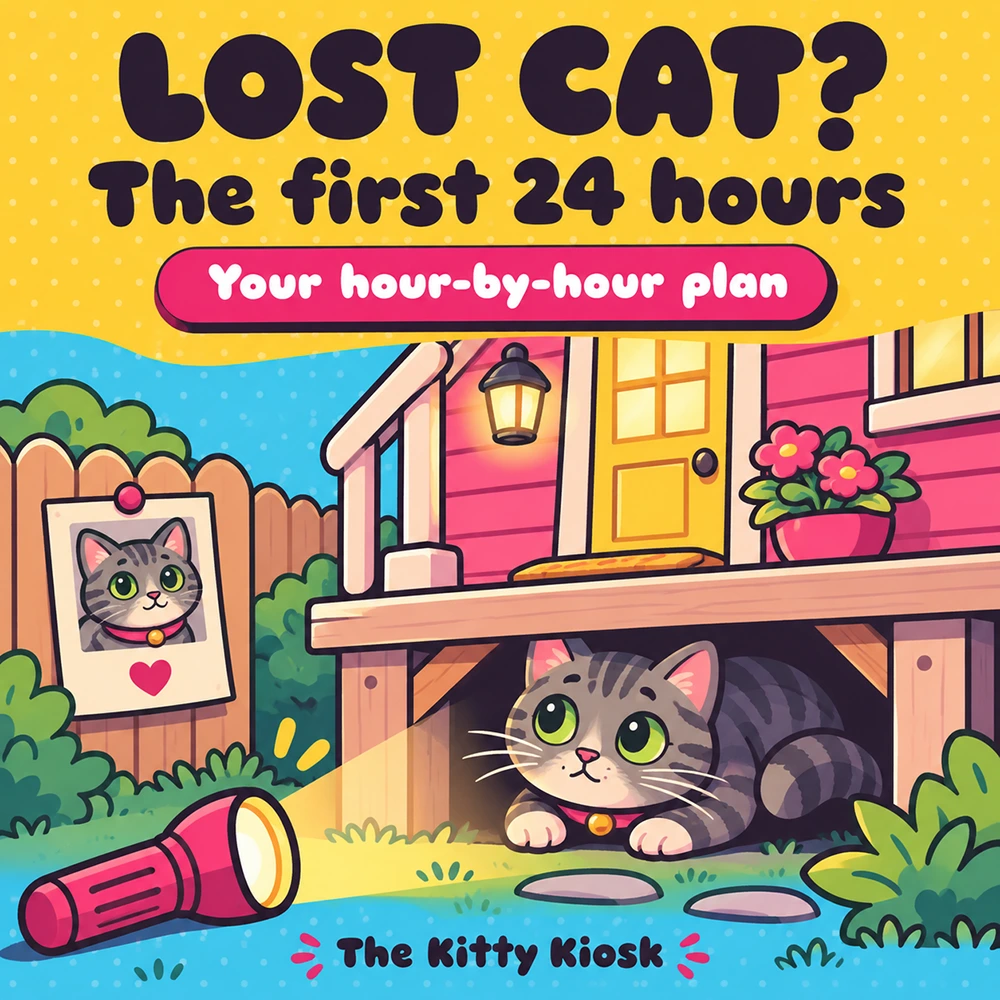
Lost cat? What to do in the first 24 hours (an hour-by-hour plan)
It usually starts with something small. The back door didn’t quite latch. The screen had a corner pulled loose. A delivery driver stood in the doorway a beat too long. Then the house goes quiet in a way you notice before you understand it, and you start calling a name that doesn’t answer.
If that is where you are right now, take one breath and read the next two sections. They matter more than anything else on this page.
We wrote this as a plan you can follow hour by hour, because panic makes everybody search in the wrong places. The good news is that the odds are on your side when you do the right things early.
The first hour: search close, slow, and quiet
Start inside. Seriously. A frightened cat can wedge itself into places you would swear are too small: inside a recliner, under the springs of a bed, behind the dryer, in the back of a closet, or up inside a kitchen cabinet with a gap at the top. Rosie’s go-to hiding spot is the space behind our bed, and she has ignored her own name from back there for the better part of an hour. Open every cabinet and closet, and use a flashlight.
Once you are sure the house is empty, go outside, but slow down. Lost cats are rarely running down the street. Far more often they are tucked under something within a few houses of home, silent and frozen, hoping nobody finds them.
A 2018 study of missing cats published in the journal Animals found that indoor-only cats were usually found very close to where they got out, and that physically searching the neighborhood found more cats than any other method. Cats that are used to going outside tend to travel farther, but even they rarely go as far as owners fear.
Walk the area slowly and look low: under porches and decks, beneath parked cars, inside bushes, along fence lines, and in window wells. Call in a normal, calm voice, then stop and listen for a full minute. A scared cat may answer with a tiny sound or not at all, and it will not come running toward a stranger’s voice or yours if you sound upset.
Hours one and two: knock on doors and ask for camera clips
Your neighbors are your best search party, and most of them will be glad to help if you ask directly.
Knock on every door within a few houses on each side and across the street. Show a photo on your phone and ask two specific things. First, can they check their garage, shed, and basement? Cats slip into open garages and get shut in all the time, and that is one of the most common places lost cats turn up. Second, do they have a doorbell or yard camera?
That second question is the one people forget. Ring, Blink, Nest, and other cameras record motion all night, and a cat crossing a driveway at 2am is exactly the kind of thing they catch. Ask neighbors to scroll back through the clips from the time your cat went missing. A single screenshot can tell you which direction to search.
Hours two to four: posters up, and post online
Paper posters still work, because the people most likely to spot your cat are the ones who walk and drive past your street every day. Keep the design simple enough to read from a moving car: “LOST CAT” in huge letters, one clear photo, your cat’s name, where and when they were last seen, and a phone number in large print.
You can make one in a couple of minutes with our free lost cat poster maker. It builds a printable poster with tear-off phone tabs plus a square image sized for social media, and you do not need an account.
Put posters up within a few blocks first: mailbox clusters, intersections, bus stops, school crossings, and the entrances to parks. Then widen out to vet clinics, pet stores, and community boards at grocery stores and laundromats.
Online, share the square image in your local Facebook lost-and-found pet groups and on Nextdoor. You can also give your cat a free listing on our Lost Cat Board, which puts them on a map, lets neighbors post sightings and camera screenshots, and emails you the moment someone does. It also adds a QR code to your poster, so anyone who sees it on a pole can report a sighting from their phone.
Hours four to eight: shelters, vets, and the microchip
Call your local animal shelter, animal control, and any nearby rescues. Then call vet clinics and the closest emergency vet, in case a good Samaritan brings in an injured cat. Give each one a description, your phone number, and ask how they log found animals.
Then go in person. Descriptions over the phone get missed (“gray cat” covers half the cats in a shelter), and stray hold periods can be short, sometimes only a few days depending on where you live. Plan to visit every couple of days, not once.
If your cat is microchipped, call the microchip company today. Confirm the chip is registered to you and that the phone number on file is current; an out-of-date number is one of the most common reasons a scanned cat does not make it home. If you are not sure which company holds the record, the AAHA Universal Pet Microchip Lookup at petmicrochiplookup.org can tell you.
After dark: the best search window of the day
This is the part most people skip, and it is often when cats are found. Once the street goes quiet, a hiding cat feels safe enough to move, and a flashlight makes their eyes shine back at you from under decks and hedges.
Go out around dusk, then again late at night and at first light. Walk slowly, stop often, and call softly. Shake a treat bag or tap a food can with a spoon if that is a sound your cat knows. If you spot them, resist the urge to grab. Sit down, look away, talk quietly, and let them come to you, even if it takes twenty minutes.
Back at home, leave something that smells like you and like them near the door they got out of: a worn T-shirt, their bed, or a blanket they sleep on. If the trail goes cold, ask your shelter or a local rescue about borrowing a humane trap. They are safe, and they catch cats who are too frightened to come to anyone.
Day two and beyond: keep going
If the first day ends without your cat, you have not failed. Cats are found weeks and even months after they go missing, often because a poster finally reached the right person or a shy cat finally got hungry enough to come out.
Keep visiting shelters in person. Refresh your online posts every few days so they stay near the top of local groups. Replace posters that have faded or blown down. Post updates on your listing when you learn something new, like a sighting a few streets over, so the people following along know where to look.
When they come home
Book a vet check, even if your cat seems fine. A few days outside can mean dehydration, small wounds, or fleas you will not spot right away.
Then take the next step to make it less likely to happen again. Make sure your cat has a microchip with up-to-date details and a breakaway collar with an ID tag carrying your phone number, which is the fastest way a neighbor can reach you. If your cat is a door-dasher, our look at GPS and Bluetooth trackers for cats covers the options. For cats who clearly want more of the outdoors, these safe indoor and outdoor compromises can take the pressure off the front door.
And if your cat goes outside regularly, our guide to outdoor cat safety covers the hazards that catch most owners off guard. Trips are another common time for escapes, so our tips for traveling with your cat are worth a look before the next car ride.
Lastly, if you listed your cat on the Lost Cat Board, mark them as found. It lets everyone who helped know the good news, and every happy ending gives hope to the next person standing in their driveway calling a name.
Loved this post? Explore more cat care tips on our cat blog, or dig into Outdoor cat safety: the five threats people forget about for a deeper look at keeping your cat safe beyond the front door.
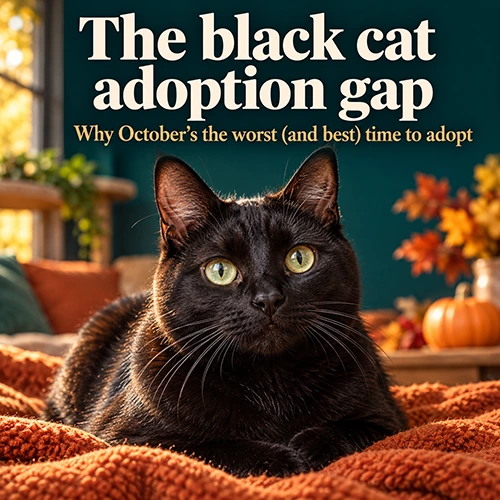
The black cat adoption gap: why October’s the worst (and best) time to adopt
Walk into a busy shelter and look at the cat room. The orange tabby by the door is getting three visitors at once. The calico is doing her best impression of a loaf in the front window. And somewhere in the back row, a black cat is sitting very still, watching everyone walk past.
That scene is familiar to a lot of shelter volunteers. Whether these cats really get adopted less often is a more complicated question than the internet tends to admit, but there is enough evidence of a real bias to take it seriously. And October, the month that leans hardest on the spooky black cat stereotype, turns out to be one of the best times to push back on it.
What the research actually says
The honest answer is that the picture is mixed. Here is what we know.
An often-cited study of one California shelter, published in 2002, found that black cats had lower adoption rates than cats of most other colors. Later research on why that might happen points to perception. In a 2019 study, psychologists showed people photos of cats in different colors and found that black cats were more often rated as less friendly and harder to read. People who scored higher for superstitious beliefs were more likely to show that bias.
On the other hand, data from some large shelter networks has not found a big gap in adoption rates by color. Results seem to vary from shelter to shelter and region to region. So rather than a universal rule, think of it as a real tendency that shows up in some places more than others.
Why black cats can get overlooked
Even without any superstition involved, a few practical things work against them.
They are hard to photograph
Most people now find their next pet online before they ever visit a shelter. A dark-coated cat in a dim kennel, shot on a phone, often turns into a dark shape with two glowing eyes. You lose their expression, the shape of their face, and any sense of personality. Shelters that have improved their photography, using better lighting and brighter backgrounds, often report that black cats get more interest as a result.
Their faces are harder to read
Much of what we read in a cat’s expression comes from contrast: the shape of the eyes, the angle of the ears, small changes around the whiskers. On a solid black face, those cues blend together. People are not wrong that black cats can be harder to read at a glance. They are wrong about what that means. It says nothing about personality.
There are simply more of them
Black is one of the most common coat colors in domestic cats. When a shelter has eight of them and one Siamese mix, the eight can look interchangeable to a casual visitor, while the Siamese stands out. Any one black cat ends up competing mostly with other black cats.
The Halloween adoption ban, and why most shelters dropped it
For years, some shelters paused black cat adoptions in the weeks before Halloween. The fear was that people might adopt them as props for parties or costumes, or that they could be harmed by people acting on superstition.
There is very little evidence that this was ever a common problem. Many shelters have since dropped the policy, and some now do the opposite, running special adoption events for them in October. The reasoning is simple. Keeping cats in the shelter for weeks based on a rare risk costs them weeks of being in a home, and it reinforces the idea that black cats are somehow spooky.
That said, it is still sensible to keep any cat, black or otherwise, indoors around Halloween. The real risks that week are ordinary ones: traffic, noise, and open doors. Our guide to the outdoor threats people forget about covers those in more detail.
Why October is a great month to adopt one
Here is the twist. The month most associated with the scary black cat stereotype is also when shelters and rescues are most likely to celebrate them. Black Cat Day falls on October 27, and many groups run reduced-fee or fee-waived adoption events around it. If you have been thinking about adopting, this is a good time to look.
It is also a good time to look at the cats people walk past for other reasons: seniors, shy cats, cats with a medical history. Our notes on caring for an older cat are a good read if a gray-whiskered black cat catches your eye.
When you meet a cat in person, give them a few minutes before you decide anything. Sit down at their level, let them come to you, and watch how they respond to a slow blink or a hand held out to sniff. A black cat who seemed aloof in a listing photo often turns out to be the one headbutting your knee five minutes later. Shelters are noisy, stressful places, and nobody shows their best self in a kennel.
What living with a black cat is actually like
There is no good evidence that coat color predicts personality in any meaningful way. These cats are as varied as any other group: lap cats, chatterboxes, troublemakers, and quiet observers. Personality comes from genetics, early socialization, and individual experience, not from the color of the fur.
What you do get is a few practical quirks. They can be nearly invisible at night, so you will learn to shuffle your feet in a dark hallway. Their fur shows up on light furniture and vanishes on dark clothing. Some black cats develop a reddish or rusty tint in strong sunlight as they age, which is normal. And they are, almost without exception, impossible to photograph well on the first try. Expect a camera roll full of dark blurs with two glowing eyes.
If you do bring one home, the first weeks matter more than the color. Our guide to introducing a new cat to your home walks through the settling-in process step by step, and the first-time cat parent essentials list covers the gear.
How to help even if you cannot adopt
Not everyone is in a position to bring home a cat this month. There are still ways to help close the gap:
- Volunteer to take photos. If you have a decent camera and some patience, shelters will be thrilled. Bright, even light and a colorful background make a huge difference for a dark coat.
- Share listings. A good photo, shared on social media with a line about their personality, can find them a home.
- Foster. A cat in a foster home can be photographed relaxed and playing, which shows off a personality a kennel photo never could.
- Donate to fee-waived events. Many rescues rely on sponsors to cover the cost of reduced-fee adoption days.
Black cats are not unlucky, and they are certainly not spooky. Sometimes they are just harder to see. This October, take a second look at the back row.
Loved this post? Explore more cat care tips on our cat blog, or dig into the story of NYC’s bodega cats for another look at cats people tend to overlook.
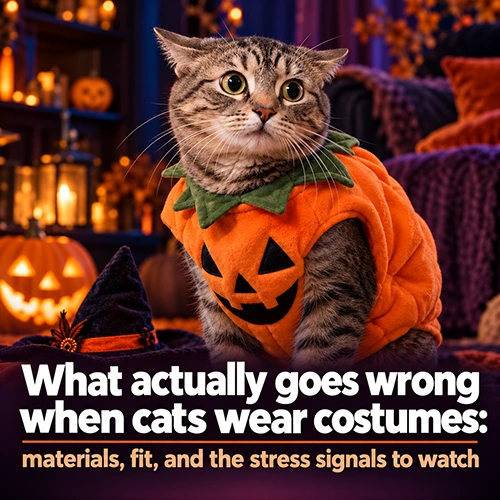
What actually goes wrong when cats wear costumes: materials, fit, and the stress signals to watch
The photo always looks the same. A cat in a pumpkin suit, or a tiny witch hat, or a lion’s mane, sitting perfectly still and staring into the camera. People see that stillness and assume the cat is fine with it.
Often, the cat is not fine with it. They are frozen.
We are not here to ban cat costumes. A lot of people enjoy them, and some cats genuinely tolerate a light outfit for a quick photo. But it helps to know what actually goes wrong, why cats react the way they do, and which kinds of costumes cause the most trouble. That way, if you do dress your cat up this Halloween, you can do it in a way that is fast, safe, and as low-stress as possible.
Why cats and costumes are a bad match
Dogs have been bred for thousands of years to work closely with people, and many of them tolerate clothing well. Cats are a different story. A few things about how they are built make costumes harder for them.
- Their skin and coat are sensitive. Cats rely on touch to understand their surroundings. Fabric pressing on their back, chest, or legs is a constant, unfamiliar signal they cannot switch off.
- Their whiskers are sensors. Whiskers help cats judge space and detect movement nearby. Anything that bends or covers them, like a hood or mask, can be genuinely disorienting.
- They hate losing control of their movement. Cats move with precision. Clothing that pulls on their legs or shifts as they walk can make them feel restricted and off balance.
- Their ears are emotional signals. Hats and headbands pin down the ears, which cats use for communication. It is a bit like having someone hold your face still while you try to talk.
The freeze, the flop, and other stress signals
The most common reaction to a costume is not panic. It is stillness. Many cats freeze when they feel restrained, and in photos that freeze reads as calm. It is better understood as a cat waiting for the uncomfortable thing to be over.
Other signs your cat is not enjoying their outfit:
- Flopping onto their side and refusing to walk.
- Walking low to the ground in a crouch, or backing up.
- Ears flattened or turned sideways.
- Wide eyes with large pupils.
- A tail that is tucked, puffed, or thrashing. Our guide to what your cat’s tail is telling you covers the full vocabulary.
- Licking their lips, or excessive grooming once the costume is off.
- Trying to wriggle out, bite, or scratch at the outfit.
The materials that cause the most trouble
Not all costumes carry the same risk. These are the features most likely to cause problems:
Elastic around the neck or chest
Tight elastic can restrict breathing and movement, and it can rub the skin raw. If a costume relies on elastic straps to stay on, it is probably too tight for a cat. Cats are also very good at getting a leg caught in a loose strap, which can be just as dangerous.
Small parts and dangling decorations
Buttons, pom-poms, sequins, bells, and loose threads are all chewable, and many are small enough to swallow. String, ribbon, and elastic cords are especially dangerous, because cats who swallow them can end up with a serious intestinal blockage that may need surgery.
Heavy or synthetic fabrics
Cats already wear a fur coat. Thick polyester costumes and plush full-body suits can trap heat, especially in a warm house full of people. Overheating is uncommon, but it is possible, and the stress of the costume adds to it.
Anything with dye, paint, or glitter
Cats groom constantly, so anything on their fur ends up in their mouth. Never use face paint, hair dye, colored spray, or glitter on a cat. Even products labeled “pet-safe” are usually designed for dogs.
Fit: how to tell if a costume is safe
If you are going to try a costume, the fit matters more than the design. A good fit for a cat looks like this:
If a costume fails any of these, skip it. A simple outfit that fits well is safer than an elaborate one that almost does.
Some cats really do not mind
To be fair to the costume fans, there are cats who handle a light outfit well. They tend to be the ones who were handled a lot as kittens, who already wear a harness for walks, or who are simply laid back about everything. If your cat walks, plays, and eats normally with a costume on, keeps their ears in a relaxed position, and does not try to remove it, a short session is probably fine.
Even then, the same rules apply. Keep it light, keep it brief, and stay close. Tolerance on Tuesday is not a guarantee on Saturday, especially with a doorbell going.
How to do a costume photo the low-stress way
If your cat seems reasonably relaxed about being handled, a quick photo can be done safely. Keep it short and on their terms.
Start by letting your cat sniff and investigate the costume on the floor for a day or two before you put it on. Have treats ready and a second person to take the photo. Put the outfit on, take a few shots quickly, then take it off. Aim for under a minute or two. Do not try for the perfect picture. Take what you get.
Rosie made her opinion on this extremely clear years ago. We tried a small bat-wing harness, she flopped onto her side like a fainting goat, and that was the end of her costume career. She has since been allowed to supervise the decorating from a safe distance, which suits everyone.
Costume ideas that skip the cat entirely
The best costume for most cats is no costume at all. If you still want a themed photo, there are other ways to get it:
- Dress the space. Put your cat’s bed in a cardboard “haunted house” or decorate their favorite box with paper bats.
- Use a photo prop. A small witch hat placed next to the cat, rather than on them, often gets the same laugh.
- Edit it in. Plenty of phone apps add costumes to a photo after the fact. Your cat will never know.
- Match your cat instead. Dress yourself up. Our cat-themed tees are a lot easier to wear than a pumpkin suit is for a cat.
If your cat is the anxious type, Halloween night has plenty of other stressors to manage. Our guide to recognizing cat anxiety will help you read the signs, whether or not a costume is involved.
Loved this post? Explore more cat care tips on our cat blog, or dig into Understanding Your Cat’s Behavior for a deeper look at the instincts behind how cats react to the world.
Your turn
Leave a comment
Tried this with your own cat? Tell us how it went. We read every comment.
You must be logged in to post a comment.
Keep reading
More from the Kiosk
Your cat is asleep on something important. Plenty of time for one more.

Winter Care for Cats: Keeping Your Kitty Warm and Happy During Cold Months
As winter sets in and temperatures drop, ensuring your feline companion stays warm, healthy, and happy becomes a top [...]

British Shorthair Cats: The Teddy Bears of the Feline World
Ever looked at a cat and thought, "That's not just a cat—that's a living, breathing teddy bear"? That's the [...]

The 5 Best Robot Cat Litter Boxes
Cats are fabulous, but let’s face it—cleaning the litter box? Not so fabulous. Thankfully, robot cat litter boxes are [...]
Still curious?
[…] more cleanly than they have any right to. Cat cafe veterans will also enjoy our wander through the most famous cats in history, where the same patterns show up across two thousand years of recorded feline drama. And if […]