
What your cat’s tail is telling you (and the three signals people read backward)
Table of Contents
You come through the door and there it is, straight up like a periscope with a small hook at the top, moving across the hallway toward you at the speed of a cat who wants something.
Most of us read that one correctly without being taught. Then, forty minutes later, the same cat is on the couch with a tail swishing back and forth, we assume happy dog, we reach out, and we get a paw for our trouble. The signal was clear. We just applied the wrong dictionary to it.
Tails are the most legible thing about cats and the most consistently misread. Worth fixing, because the tail usually declares itself a good two or three seconds before the teeth get involved.
How the tail actually works as a signal
There is a rough rule that makes everything else easier to remember.
The base of the tail tells you intent. Up, down, or tucked, that is the headline: confident, cautious, or frightened. The tip tells you arousal, meaning how switched on your cat is at that moment, and arousal is not the same as mood. A cat can be delighted and highly aroused, which is how a friendly greeting turns into a grab.
The other thing to know is that this system is largely aimed at us and at other cats, not at the wider world. Domestic cats hold their tails upright at each other and at people constantly, and their wild relatives mostly do not. That posture appears to be something the species developed while living alongside us, which makes the raised tail one of the few pieces of cat vocabulary invented for the relationship rather than inherited.
The upright tail is the closest thing to a hello
An approaching cat with a vertical tail is signaling friendly intent, and studies of cat greeting behavior back this up plainly. Cats approach a raised tail. They hesitate at a lowered one.
The little hook at the top, the question mark shape, is the same message with a bit more enthusiasm behind it. It often means an invitation to interact, which may be play, may be food, and is occasionally just a request that you acknowledge the existence of the cat.
If you want to answer in the same language, the reply is not a stroke. It is a slow blink, which is a well documented way of returning the friendliness. Our piece on what cats say with their eyes gets into why that works.
The rest of the vocabulary
Once the base and tip rule is in your head, most of these read themselves.
- Straight up, tip relaxed. Confident, sociable, open to contact.
- Up with a question mark hook. Friendly and inviting. Something is being requested.
- Held low and level. Neutral to wary. Common in a cat working out a new situation.
- Tucked tight under the body. Fear or appeasement. This cat wants the situation to end.
- Puffed up and stiff, often with an arched back. Startled and defensive. The size increase is the whole point.
- Wrapped neatly around the body while sitting. Self-contained. Usually calm, sometimes cold, not an invitation.
- Draped over another cat, or around your ankle. Affiliative contact. This is a cat choosing you.
- Low and slowly sweeping, whole tail. Focused and possibly annoyed. Watch the ears.
None of these are absolute, and individual cats have accents. A cat with a bobtail or an old injury has a smaller vocabulary to work with, and their humans learn to read ears and posture harder to compensate.
The three signals people read backward
These are the ones worth committing to memory, because getting them wrong has consequences.
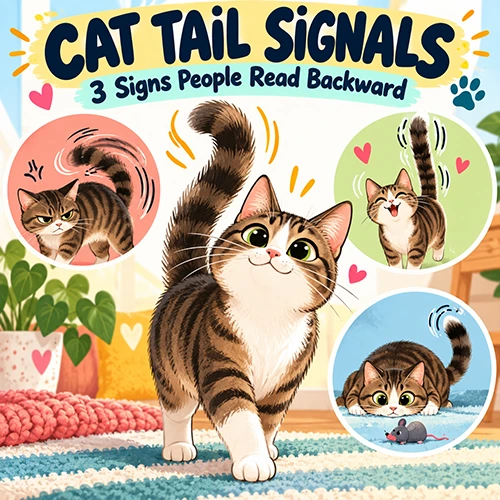
1. The thrashing tail is not a wag
This is the big one, and it comes from applying dog rules to a cat.
A dog wagging its tail is broadly saying yes. A cat swishing hard, thumping the couch, or whipping the tail side to side is saying the opposite: irritation, conflict, or a level of arousal that is about to spill over. In a cat lying on their side accepting belly rubs, that thump is the two second warning before the grab.
The tell is speed and force. Slow and loose is a cat thinking. Fast and hard is a cat done thinking.
2. The quivering upright tail is usually a greeting
A vertical tail vibrating rapidly at the tip, aimed at you as your cat trots over, is high excitement. It shows up most around feeding time and homecomings, and it is a good thing.
The confusion is that the same posture is used for urine marking. The difference is easy to spot once you know: a marking cat backs up to a vertical surface first, and the tail quiver comes with a small squirt at nose height. A greeting cat is coming toward you across open floor. Same tail, different context, completely different meaning.
3. The still tail with the twitching tip is not relaxed
A cat crouched at the window, tail flat on the floor, tip flicking. People read the stillness as calm. It is the opposite.
That is a hunting posture, and the flick is the arousal leaking out. It is also the exact state where redirected aggression happens, which is when a cat locked onto something they cannot reach, usually another cat outside the window, turns on whoever is closest. If you see that tail tip going while your cat stares out the window, that is the moment to leave them be, not to scoop them up.
Read the whole cat, not just the tail
No single body part gives you a reliable answer on its own, and the tail is the loudest voice in a small choir.
Ears rotated sideways or flattened outrank a friendly tail every time. Pupils blown wide in a bright room mean arousal or fear. Whiskers fanned forward mean interest, pinned back against the cheeks mean the cat is closing down. Weight shifted back over the hips means a cat preparing to move away from you.
When the signals disagree, believe the more defensive one. A cat with a high tail and flattened ears is not sending a mixed message. They are sending a clear one that started friendly and changed partway through, which happens constantly during petting sessions. The rest of the everyday signals get covered in our guide to why cats knead, purr, and zoom around.
What this is actually for
The practical payoff is that you stop being surprised.
Most of the bites and scratches that people describe as unprovoked were preceded by a tail doing something obvious for several seconds. Once you can see it, petting sessions end on your terms rather than the cat’s, and the relationship gets noticeably easier. It works in the other direction too. Knowing that Rosie’s tail goes up the second she hears the cupboard is a small daily pleasure that we would not have noticed a few years ago.
Cats are not subtle. They are just quiet, and they speak with the part of the body most people are not watching. If any of this is new, our recent piece on the 3am toy delivery is another behavior that makes far more sense once you know what to look for.
Loved this post? Explore more cat care tips on our cat blog, or read Cat Anxiety: Tell-Tale Behavior, Causes, and Remedies for what these signals look like when a cat is genuinely stressed.
About the Author: Milly Brown


Disclosure: This post contains affiliate links. If you purchase through these links, we may earn a commission at no extra cost to you.



[…] tail that is tucked, puffed, or thrashing. Our guide to what your cat’s tail is telling you covers the full […]