
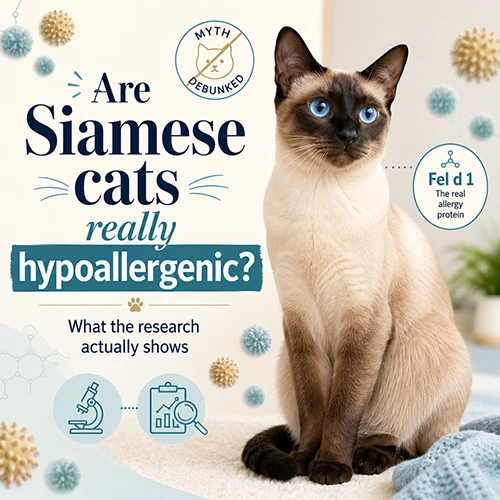
Are Siamese cats really hypoallergenic? What the research actually shows
Table of Contents
The claim gets repeated with total confidence, usually by somebody who is not selling you anything and genuinely believes it. Short coat, minimal shedding, therefore easier on allergies. It sounds like it should follow.
It does not follow. And the gap between what people believe about this and what the immunology actually says is one of the wider gaps in the whole breed-selection conversation.
Here is what the research supports, what it does not, and what to do if you are allergic and have your heart set on a pair of blue eyes anyway.
The protein doing all the damage
Cat allergy is, for most people, an allergy to one specific protein: Fel d 1. Around 95% of cat-allergic patients react to it, which is unusual. Most allergies are messier and spread across several targets.
Fel d 1 is produced in the sebaceous glands of the skin, in saliva, and in the anal glands. Cats then distribute it across their entire coat by grooming, which they do for a large fraction of their waking hours. The fur is the delivery vehicle. It is not the source.
This distinction is the whole article, so it is worth sitting with. A hairless cat still produces the protein. A cat that never sheds a visible hair still produces the protein. Shaving a cat does not reduce production, it just changes how the protein gets around the room.
And it gets around efficiently. Fel d 1 particles are roughly 10 microns across, light enough to stay airborne for hours and sticky enough to bind to walls, upholstery, and clothing. Researchers have found measurable levels in homes that have never housed a cat, and in schools and offices, carried in on people’s clothes.
Where the myth actually came from
Two threads got tangled, and the knot has held for decades.
The first is the shedding confusion above. A sleek color-pointed cat leaves less visible hair on a black sweater than a Maine Coon does, and people reasonably assume less hair means less allergen. What they are actually noticing is less mess.
The second thread is more specific and more interesting. The hypoallergenic claim in this family of cats is most often attached to the Balinese, which is essentially a long-haired variant of the same breed line. Balinese cats have been described in breeder literature for years as producing less Fel d 1. That claim has never been supported by controlled measurement in a peer-reviewed setting. It circulated anyway, and over time it drifted sideways onto the short-haired relatives, where it merged with the shedding assumption and became received wisdom.
So the popular claim rests on an unproven assertion about a different cat, plus a variable that turns out not to matter. That is a shaky foundation for a fifteen-year commitment.
If you want the honest version of what these cats are actually like to live with, our full breed profile covers the temperament, the volume, and the shadowing behavior in detail. Allergies aside, they are not a low-input pet.
What genuinely does vary, cat to cat
Here is the part that gets buried, and it is far more useful than the breed question.
Fel d 1 production varies by a factor of ten or more between individual cats. Not between breeds. Between individuals. Two cats of the same breed, same litter, can sit at opposite ends of that range, and there is currently no way to predict which is which by looking.
A few patterns hold up reasonably well in the literature:
- Sex matters. Males produce more than females, consistently.
- Neutering matters more. Intact males produce substantially more than neutered ones, and levels drop measurably after neutering. This is the single largest controllable factor.
- Age plays a part. Kittens produce less than adults, which is why the “I was fine with him as a kitten” experience is so common and so demoralizing about six months later.
- Coat color is irrelevant. The dark-cats-are-worse claim shows up constantly and has not held up under measurement.
Put bluntly: a neutered female of almost any breed is a better statistical bet than an intact male of the breed you were told was safe.
So is this breed a worse choice for an allergic household?
No, and that is worth saying plainly. Nothing here argues against the breed. It argues against the reasoning.
There is a genuine, modest practical advantage to a short single coat, and it is not immunological. Less fur in the air means fewer of those coated hairs landing on your pillow, less accumulation in rugs, and an easier job keeping surfaces clear. For someone with mild symptoms and a good cleaning routine, that can be the difference between manageable and not.
What it will not do is protect a person with significant cat allergy. If your reaction involves your chest rather than your eyes and nose, breed selection is the wrong lever entirely, and no amount of grooming discipline will substitute for talking to an allergist first.
What actually reduces symptoms
The measures with real evidence behind them are unglamorous and mostly environmental.
The grooming point is doing more work than it looks like. Getting loose hair off the cat and into a trash bag, rather than onto the couch, is the most direct lever a cat owner controls, and our guide to grooming technique walks through doing it without a wrestling match.The honest recommendation
Pick the cat for the life you want to live with it, then manage the allergy as a separate problem with separate tools.
These are loud, sociable, intensely people-oriented animals who will follow you into the bathroom and comment on your day. That is the actual decision in front of you. Whether they are easier on your sinuses than a tabby from the shelter down the road is, on the current evidence, close to a coin toss weighted by that particular animal’s sex and neuter status rather than its pedigree.
If you are still narrowing the field, our breed comparison rundown is a reasonable next stop, and if space is part of the equation, the small-apartment breed picks weigh temperament against square footage.
Loved this post? Explore more cat care tips on our cat blog, or dig into Siamese Cats: The Blue-Eyed Charmers With a Royal Past for the full picture on living with the breed.
About the Author: Milly Brown


Disclosure: This post contains affiliate links. If you purchase through these links, we may earn a commission at no extra cost to you.