
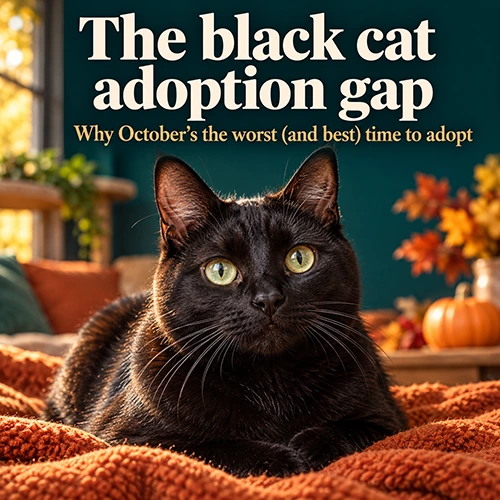
The black cat adoption gap: why October’s the worst (and best) time to adopt
Table of Contents
Walk into a busy shelter and look at the cat room. The orange tabby by the door is getting three visitors at once. The calico is doing her best impression of a loaf in the front window. And somewhere in the back row, a black cat is sitting very still, watching everyone walk past.
That scene is familiar to a lot of shelter volunteers. Whether these cats really get adopted less often is a more complicated question than the internet tends to admit, but there is enough evidence of a real bias to take it seriously. And October, the month that leans hardest on the spooky black cat stereotype, turns out to be one of the best times to push back on it.
What the research actually says
The honest answer is that the picture is mixed. Here is what we know.
An often-cited study of one California shelter, published in 2002, found that black cats had lower adoption rates than cats of most other colors. Later research on why that might happen points to perception. In a 2019 study, psychologists showed people photos of cats in different colors and found that black cats were more often rated as less friendly and harder to read. People who scored higher for superstitious beliefs were more likely to show that bias.
On the other hand, data from some large shelter networks has not found a big gap in adoption rates by color. Results seem to vary from shelter to shelter and region to region. So rather than a universal rule, think of it as a real tendency that shows up in some places more than others.
Why black cats can get overlooked
Even without any superstition involved, a few practical things work against them.
They are hard to photograph
Most people now find their next pet online before they ever visit a shelter. A dark-coated cat in a dim kennel, shot on a phone, often turns into a dark shape with two glowing eyes. You lose their expression, the shape of their face, and any sense of personality. Shelters that have improved their photography, using better lighting and brighter backgrounds, often report that black cats get more interest as a result.
Their faces are harder to read
Much of what we read in a cat’s expression comes from contrast: the shape of the eyes, the angle of the ears, small changes around the whiskers. On a solid black face, those cues blend together. People are not wrong that black cats can be harder to read at a glance. They are wrong about what that means. It says nothing about personality.
There are simply more of them
Black is one of the most common coat colors in domestic cats. When a shelter has eight of them and one Siamese mix, the eight can look interchangeable to a casual visitor, while the Siamese stands out. Any one black cat ends up competing mostly with other black cats.
The Halloween adoption ban, and why most shelters dropped it
For years, some shelters paused black cat adoptions in the weeks before Halloween. The fear was that people might adopt them as props for parties or costumes, or that they could be harmed by people acting on superstition.
There is very little evidence that this was ever a common problem. Many shelters have since dropped the policy, and some now do the opposite, running special adoption events for them in October. The reasoning is simple. Keeping cats in the shelter for weeks based on a rare risk costs them weeks of being in a home, and it reinforces the idea that black cats are somehow spooky.
That said, it is still sensible to keep any cat, black or otherwise, indoors around Halloween. The real risks that week are ordinary ones: traffic, noise, and open doors. Our guide to the outdoor threats people forget about covers those in more detail.
Why October is a great month to adopt one
Here is the twist. The month most associated with the scary black cat stereotype is also when shelters and rescues are most likely to celebrate them. Black Cat Day falls on October 27, and many groups run reduced-fee or fee-waived adoption events around it. If you have been thinking about adopting, this is a good time to look.
It is also a good time to look at the cats people walk past for other reasons: seniors, shy cats, cats with a medical history. Our notes on caring for an older cat are a good read if a gray-whiskered black cat catches your eye.
When you meet a cat in person, give them a few minutes before you decide anything. Sit down at their level, let them come to you, and watch how they respond to a slow blink or a hand held out to sniff. A black cat who seemed aloof in a listing photo often turns out to be the one headbutting your knee five minutes later. Shelters are noisy, stressful places, and nobody shows their best self in a kennel.
What living with a black cat is actually like
There is no good evidence that coat color predicts personality in any meaningful way. These cats are as varied as any other group: lap cats, chatterboxes, troublemakers, and quiet observers. Personality comes from genetics, early socialization, and individual experience, not from the color of the fur.
What you do get is a few practical quirks. They can be nearly invisible at night, so you will learn to shuffle your feet in a dark hallway. Their fur shows up on light furniture and vanishes on dark clothing. Some black cats develop a reddish or rusty tint in strong sunlight as they age, which is normal. And they are, almost without exception, impossible to photograph well on the first try. Expect a camera roll full of dark blurs with two glowing eyes.
If you do bring one home, the first weeks matter more than the color. Our guide to introducing a new cat to your home walks through the settling-in process step by step, and the first-time cat parent essentials list covers the gear.
How to help even if you cannot adopt
Not everyone is in a position to bring home a cat this month. There are still ways to help close the gap:
- Volunteer to take photos. If you have a decent camera and some patience, shelters will be thrilled. Bright, even light and a colorful background make a huge difference for a dark coat.
- Share listings. A good photo, shared on social media with a line about their personality, can find them a home.
- Foster. A cat in a foster home can be photographed relaxed and playing, which shows off a personality a kennel photo never could.
- Donate to fee-waived events. Many rescues rely on sponsors to cover the cost of reduced-fee adoption days.
Black cats are not unlucky, and they are certainly not spooky. Sometimes they are just harder to see. This October, take a second look at the back row.
Loved this post? Explore more cat care tips on our cat blog, or dig into the story of NYC’s bodega cats for another look at cats people tend to overlook.
About the Author: Milly Brown


Disclosure: This post contains affiliate links. If you purchase through these links, we may earn a commission at no extra cost to you.