
Why your cat sheds in clumps every spring (and the brushing routine that actually works)
Table of Contents
Somewhere around late March, our sofa starts producing a slow, drifting tumbleweed of grey-brown fluff. By April there’s a full second cat’s worth of it on the lint roller. By May we’ve vacuumed twice and given up.
If this is happening at your house too, the cat is fine. Spring fluff-loss is one of the most predictable annual events in feline ownership, and most of it is biology doing exactly what it’s supposed to do. The bit worth understanding is when it shifts from “annoying” to “this isn’t right”, and what changes about the brushing routine to actually stay ahead of it instead of constantly chasing it.
What’s actually happening in spring
Cats have two layers of fur. The top is the guard hairs, the longer, glossier fibers you see when they walk past a window. Underneath is a much shorter, much denser layer doing most of the thermal work. The two shed on different cycles, and in spring that hidden underlayer goes through what biologists call a synchronous molt: a large fraction of those short hairs all decide to leave at roughly the same time.
The trigger isn’t temperature, despite what most of us assume. It’s day length. As daylight stretches past about 11 hours, a chain of hormonal signals tells the hair follicles to push out the winter fluff and slow new growth until autumn. This is why house cats who never go outside still shed on the seasonal schedule, the photoperiod cue gets through windows just fine.
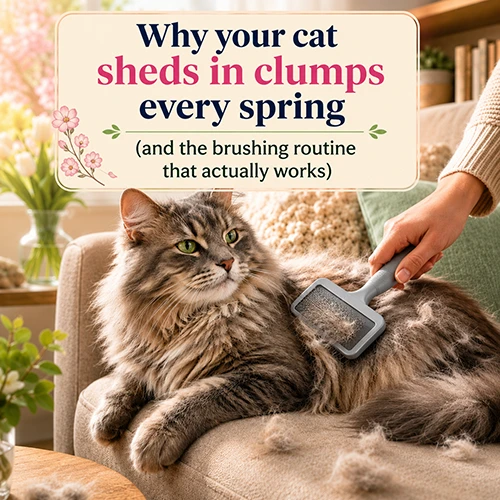
The clumps you’re finding aren’t matting, usually. They’re felted fluff: short hairs pushed out by new growth but caught in the surrounding guard hairs instead of falling free. Rosie, who carries the most committed winter layer we’ve ever lived with, produces these in springtime at a rate that would suggest a different animal is shedding all over the house entirely.
Normal shed vs. something to flag
Three things separate “April clumps” from “see the vet this week”:
- Bald patches. Healthy molting thins evenly. If you can see skin through a defined patch, particularly the belly, hind legs, or base of the tail, that’s not normal. That’s a flag for fleas, ringworm, stress overgrooming, or an endocrine issue.
- Red, flaky, or greasy skin. A normal seasonal change leaves the skin underneath looking the same as it did in February. Visible irritation under the fur is its own problem.
- A sudden cliff in timing. Spring molt is gradual, it builds over two or three weeks and tapers similarly. A cat who looks normal on Friday and is suddenly shedding in handfuls on Monday warrants a check, especially if they’re over ten.
Everything else, the lint-roller-defying volume, the tumbleweeds, the fur in your tea, is just cats being cats in April. Volume varies wildly by breed and individual; long-haired breeds like Maine Coons and Persians can lose what looks like an alarming amount and still be entirely fine.
The brushing routine that actually works
The mistake most owners make in spring is reaching for the same brush they use in November. Winter grooming is mostly about distributing skin oils. April work is about physically pulling the loose underlayer free before it ends up on the soft furnishings.
What we’ve landed on after a lot of trial and error:
- Daily, short sessions. Five minutes a day beats twenty minutes once a week, by miles.
- Two tools, not one. Wide-tooth comb first to break up felted clumps, then a slicker-style deshedder for the bulk of it.
- Work along the lie of the fur. Against the grain is faster but cats hate it.
- Start at the head, end at the tail. Front-load the part they actually enjoy.
- Have a treat ready. Pays compound dividends in October when it’s time to do it all again.
Our deeper grooming guide covers the specific tool choices for short, medium, and long-haired cats, worth a read if your current brush feels like it isn’t doing much.
The diet and hydration angle nobody mentions
A surprising amount of “my cat sheds too much” turns out to be related to fur condition, which is downstream of diet and water intake. Two things help measurably:
Wet food, in any form, every day. Cats are bad at drinking water relative to dogs, and a dehydrated animal produces duller, more brittle hair that’s more prone to breakage and matting. If yours is on dry food only, mixing in even a single 2.5-ounce pouch of wet a day will noticeably improve things over a couple of months.
Omega-3s. Salmon oil, krill oil, or a vet-recommended supplement adds essential fatty acids that support sheen and skin barrier function. The effect is slow, you’re not seeing changes in a week, but in our experience it’s the single biggest lever you can pull on an animal that always looks a bit rough.
If your cat goes outside
Indoor-outdoor cats shed slightly less dramatically than purely indoor ones, weirdly enough, because their photoperiod cues are sharper and the molt is more concentrated. They also bring in more loose fluff, particularly if they’re rubbing along bushes and fences, so you may find less of it on your sofa and more of it caught in the hedge.
The other adjacent issue for outdoor wanderers is parasites. Fleas, mites, and ticks can mimic or exacerbate a normal spring molt, and the symptoms layer in a way that’s hard to tease apart without a vet check. Worth thinking about as part of the broader indoor-versus-outdoor question if you’re still figuring out which set-up suits your cat.
When to call the vet
To recap the flags from earlier, in order of urgency:
- Bald patches or visible skin showing through, same-week vet visit.
- Red, flaky, or greasy skin underneath, same-week vet visit.
- Excessive grooming, especially focused on one spot, book within two weeks.
- A cat over ten with any sudden change in condition, book within two weeks, paired with a weight check.
- Fur that “just looks rough” with no other symptoms in an otherwise healthy animal, try the diet adjustments first; revisit if no improvement in six to eight weeks.
For everything else? Brush a little more, vacuum a little more, and remember that by mid-June the worst of it will have passed and you’ll have a sleek summer cat for about three months before the cycle starts again.
Loved this post? Explore more cat care tips on our cat blog, or dig into our complete cat grooming guide for tool recommendations and breed-specific routines.
About the Author: Milly Brown


Disclosure: This post contains affiliate links. If you purchase through these links, we may earn a commission at no extra cost to you.