Outdoor cat safety: the five threats people forget about until it’s too late
Table of Contents
Ask any cat owner what worries them about letting their pet roam, and you’ll hear the same three things: cars, dogs, and predators. They’re the headline risks for a reason. They also account for a smaller share of outdoor-cat emergencies than most people assume.
The threats that catch owners off guard are quieter. They don’t make headlines. They show up at the vet on a Sunday afternoon when nobody saw anything happen. We’ve been around cats long enough to have heard most of these stories second-hand, and a few first-hand, and the pattern is always the same: owners describe the visible risks they were watching for, then look bewildered when the actual cause turns out to be something they’d never considered.
Here are five of those quieter dangers, and what to do about each. If you’re still working through the broader question of whether your cat should be outside at all, our indoor-outdoor dilemma piece is the bigger-picture conversation.
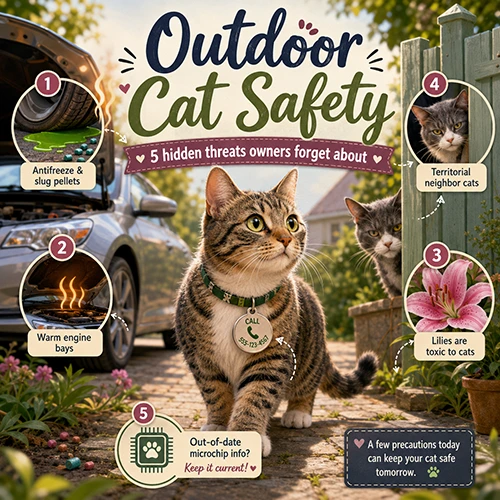
1. Antifreeze and slug pellets
That stuff tastes sweet. Ethylene glycol, the active ingredient in most antifreeze products, has a syrupy quality that cats will lick from a puddle or driveway without hesitation. Even a teaspoon can cause acute kidney failure in a small animal. The window for treatment is short, usually 8 to 12 hours from ingestion, and the early symptoms (a slightly drunk-looking gait, increased thirst) are easy to write off as the cat being weird.
Slug pellets sit in the same family of risk: brightly colored, mildly sweet, often scattered in neighboring gardens by people who don’t have pets and don’t realize yours come through. Metaldehyde, the active ingredient in older formulations, causes seizures within an hour or two.
2. Hot parked cars in summer
This one always sounds wrong when we say it out loud. The cat is outdoors and not enclosed, so how does a parked vehicle threaten them? The answer: they go inside. Cats slip into open windows, climb into half-open trunks when owners are loading shopping, or wedge themselves under the hood of warm engine bays for the heat. In summer, an outdoor wanderer trapped for 20 minutes is a heat-stroke risk in a way that surprises every owner who hears about it for the first time.
The under-hood variant is the more common one. Cats love warm engine compartments year-round. In summer they’re climbing into bays that aren’t fully cool yet from the previous drive, and in winter they’re using freshly-stopped cars as a heated shelter. A few seconds of horn-tapping or wheel-thumping before you start the engine has saved more pets than any single piece of advice on this list.
3. Lilies in next door’s bouquet
This one is among the most under-discussed risks in suburban pet ownership. All parts of true lilies (Lilium and Hemerocallis species) are nephrotoxic to cats. Pollen brushed against the fur and then licked off is enough to cause kidney damage. The peak risk windows are Easter, Mother’s Day, and Christmas, the times of year when cut flowers show up in neighboring kitchens and then end up in the compost bin where your roaming pet investigates.
The symptoms come on slowly. Vomiting at first, then increased thirst over 24 to 48 hours, then visible deterioration. By the time most owners realize something is wrong, the damage is well underway. Treatment is possible but it’s a longer recovery the later you catch it.
4. The territorial neighbor’s cat
Cat-on-cat aggression in neighborhoods causes more vet visits than wild predators, by a wide margin. Most fights happen at dawn or dusk between two unspayed or unneutered males over a contested territory boundary. The injuries are usually small puncture wounds that look harmless on the day and then abscess three or four days later, sometimes spectacularly.
The other failure mode is what behaviorists call “redirected aggression at the window,” which sounds funny until you’ve cleaned up after it. Indoor pets who see an interloper through the glass can turn on their housemates within seconds. Rosie has done this exactly once in her life, and we still talk about it. The outdoor side of this problem is what’s usually behind the wounds you find the morning after.
5. The microchip you forgot to update
This one isn’t dramatic, it’s just incredibly common. The pet is chipped, that’s why you spent the money, but the address on file is your old place from before the move, and the phone number is the one you cancelled last year. The shelter scans, can’t reach anyone, and your cat sits unidentified for the week strays are held before being re-listed for adoption.
These details are the single most overlooked piece of outdoor-pet preparation. Every house move, every phone number change, every change of partner if they were a primary contact, all of it needs to flow through to the registry. Most providers let you update online in about five minutes.
The honorable mentions
A few others worth knowing about, in shorter form:
- Garden netting. Pea netting, fruit cage netting, and football goals can entangle a cat in a way that requires emergency intervention.
- Open-top water butts. Outdoor pets fall into them more than you’d expect, particularly thirsty older animals reaching for a drink.
- Recliners and conservatory mechanisms. They climb inside both. Always check before reclining.
- Loose collar elastic. A worn-out breakaway that doesn’t break away anymore is worse than no collar at all.
And if you’re considering taking some of the outdoor experience back inside, supervised garden time on a harness, or a window catio, our leash training walkthrough is a good place to start. It’s slower than just opening the door, but the trade-off in safety is significant. Same logic applies to the broader topic of getting cats comfortable with the outside world on your terms.
Loved this post? Explore more cat care tips on our cat blog, or read our indoor-outdoor dilemma deep-dive if you’re still working through the big question of whether your cat should be outside at all.
About the Author: Milly Brown


Disclosure: This post contains affiliate links. If you purchase through these links, we may earn a commission at no extra cost to you.